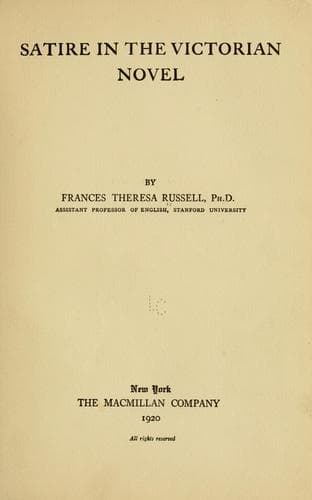
Satire in the Victorian novelRussell, Frances Theresa
History
Satire in the Victorian novel
Russell, Frances Theresa
English fiction -- 19th century -- History and criticism; Satire, English -- History and criticism; Thesis (Ph. D.)
“And all the while the broad still moon stared down on them grim
and cold, as if with a saturnine sneer at the whole humbug; and
the silly birds about whom all this butchery went on, slept
quietly over their heads, every one with his head under his
wing. Oh! if the pheasants had but understanding, how they would
split their sides with chuckling and crowing at the follies
which civilized Christian men perpetrate for their precious
sake!”
That Lytton should gain in poise and subtlety in the forty-five years
intervening between _Pelham_ and _Kenelm Chillingly_ is to be expected,
although the progression is by no means a steady one. Some of his most
absurd sarcastic moralizing is found in _My Novel_, about midway in
time,--particularly on the March of Enlightenment, with a smart sketch
of half a dozen typical Marchers; and on liberal notions generally. And
in the youthful volume are some very good touches, as this concerning
his country uncle:[180]
“He was, as people justly observed, rather an odd man: built
schools for peasants, forgave poachers, and diminished his
farmers’ rents; indeed, on account of these and similar
eccentricities, he was thought a fool by some, and a madman by
others.”
This pales perceptibly, however, by the side of Peacock’s firm and
vivid treatment of the same subject, embodied in Squire Crochet:[181]
“He could not become, like a true-born English squire, part
and parcel of the barley-giving earth; he could not find
in game-bagging, poacher-shooting, trespasser-pounding,
footpath-stopping, common-enclosing, rack-renting, and all
the other liberal pursuits and pastimes which make a country
gentleman an ornament to the world, and a blessing to the poor;
he could not find in these valuable and amiable occupations,
and in a corresponding range of ideas, nearly commensurate with
that of the great king Nebuchadnezzer, when he was turned out to
grass; he could not find in this great variety of useful action,
and vast field of comprehensive thought, modes of filling up his
time that accorded with his Caledonian instinct.”
This in turn is quite equaled by Kenelm’s coming-of-age speech, though
his indictment of the genus squire is couched in unironical satire. Not
that the youth was unacquainted with the uses of irony. At the age of
nine he had had occasion to send a letter to a schoolmate, conveying
his conviction of that lad’s lack of intelligence. He had heard his
father remark that a certain neighbor was an ass, and that he was
going to write and tell him so. He made inquiries into the matter of
phrasing such information. He received the following reply,--by which
he profited most effectively in his own correspondence:[182]
Public-domain text, read in full here on John Shaqi.
Reviews
Reviews
No reviews yet
Be the first to share your thoughts on this work.
Elsewhere in the archive
Join the Discussion
Join the discussion
Sign in to leave a comment or review.
Sign InorCreate an account