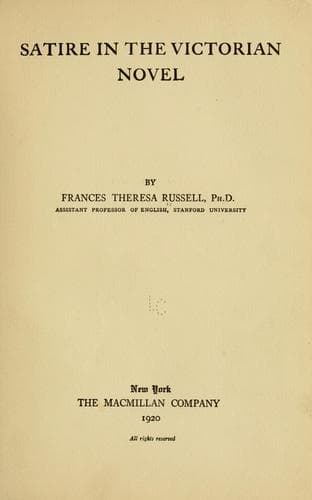
Satire in the Victorian novelRussell, Frances Theresa
History
Satire in the Victorian novel
Russell, Frances Theresa
English fiction -- 19th century -- History and criticism; Satire, English -- History and criticism; Thesis (Ph. D.)
“But you can not learn too early this fact, that irony is to
the high-bred what billingsgate is to the vulgar; and when one
gentleman thinks another gentleman is an ass, he does not say it
point-blank--he implies it in the politest terms he can invent.”
This principle is applied on a national scale in the discourse of the
intruder among the Vrilya, whose situation resembles that of Gulliver
eulogizing to the king of the Brobdingnagians the Institutions of
England, except that Lytton does not blunt his irony by relapsing into
plain terms, as Swift does in the “pernicious race of little odious
vermin.” The visitor waxes eloquent about America:[183]
“Naturally desiring to represent in the most favorable colors
the world from which I came, I touched but slightly, though
indulgently, on the antiquated and decaying institutions of
Europe, in order to expatiate on the present grandeur and
prospective pre-eminence of that glorious American Republic,
in which Europe enviously sees its model and tremblingly
foresees its doom. Selecting for an example of the social life
of the United States that city in which progress advances at
the fastest rate, I indulged in an animated description of the
moral habits of New York. Mortified to see, by the faces of my
listeners, that I did not make the favorable impression I had
anticipated, I elevated my theme; dwelling on the excellence of
democratic institutions, their promotion of tranquil happiness
by the government of party, and the mode in which they diffused
such happiness throughout the community by preferring, for the
exercise of power and the acquisition of honors, the lowest
citizens in point of property, education, and character.”
This is the ironic version of Matthew Arnold’s polished dubiety about
majorities in _Numbers_; and of the robustious satire of Dickens. If we
feel that Lytton excels the latter in pithy conciseness and allusive
point, we have to remember that he was at this time more than twice the
age of Dickens when _Martin Chuzzlewit_ was written, and that in the
intervening quarter century some improving changes had taken place in
their common object of satire.
Disraeli’s irony is less tangible and quotable. His favorite method is
to hint at the implication in a burlesque comparison; as in the opening
sentence of _The Young Duke_:[184]
“George Augustus Frederick, Duke of Saint James, completed
his twenty-first year, an event which created almost as great
a sensation among the aristocracy of England as the Norman
Conquest.”
Later his toilette is described in terms of a campaign, concluding,[185]
“He assumes the look, the air that befit the occasion: cordial,
but dignified; sublime, but sweet. He descends like a deity from
Olympus to a banquet of illustrious mortals.”
Public-domain text, read in full here on John Shaqi.
Reviews
Reviews
No reviews yet
Be the first to share your thoughts on this work.
Elsewhere in the archive
Join the Discussion
Join the discussion
Sign in to leave a comment or review.
Sign InorCreate an account