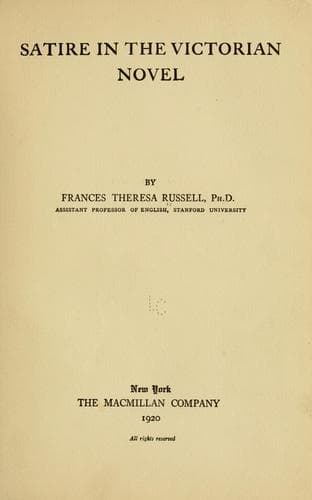
Satire in the Victorian novelRussell, Frances Theresa
History
Satire in the Victorian novel
Russell, Frances Theresa
English fiction -- 19th century -- History and criticism; Satire, English -- History and criticism; Thesis (Ph. D.)
“This affords charming food for contemplation. It shows us
what a charming thing human nature may be made to be; and how
impartially the same amiable qualities are developed in the
finest lord and the dirtiest charity-boy.”
Another is the Chuzzlewit Family, introduced by a long prologue of
ironic symbolism. Specifically there is the eulogy of the head of the
present branch of it:[191]
“Some people likened him to a direction post, which is always
telling the way to a place, and never goes there: but these were
his enemies; the shadows cast by his brightness; that was all.”
Later in his illustrious career, he is upheld in his holy horror at the
mercenary diplomacy of a landlady. Mr. Pecksniff rebukes,--
“Oh, Baal, Baal! Oh my friend, Mrs. Todgers! To barter away
that precious jewel, self-esteem, and cringe to any mortal
creature--for eighteen shillings a week!”
And Dickens echoes,[192]
“Eighteen shillings a week! Just, most just, they censure,
upright Pecksniff! Had it been for the sake of a ribbon, star,
or garter; sleeves of lawn, a great man’s smile, a seat in
parliament, a tap upon the shoulder from a courtly sword; a
place, a party, or a thriving lie, or eighteen thousand pounds,
or even eighteen hundred,--but to worship the golden calf for
eighteen shillings a week! Oh pitiful, pitiful!”
Two more characteristic instances may be cited. The first is concerning
the failure of the firm of Dombey and Son.[193]
“The world was very busy now, forsooth, and had a deal to say.
It was an innocently credulous and a much ill-used world. It was
a world in which there was no other sort of bankruptcy whatever.
There were no conspicuous people in it, trading far and wide
on rotten banks of religion, patriotism, virtue, honor. There
was no amount worth mentioning of mere paper in circulation, on
which anybody lived pretty handsomely, promising to pay great
sums of goodness with no effects. There were no shortcomings
anywhere, in anything but money. The world was very angry
indeed; and the people especially who, in a worse world, might
have been supposed to be bankrupt traders themselves in shows
and pretenses, were observed to be mightily indignant.”
The second is anent the Whelp, Tom Gradgrind.[194]
“It was very remarkable that a young gentleman who had been
brought up under the continuous system of unnatural restraint,
should be a hypocrite; but it was certainly the case with Tom.
It was very strange that a young gentleman who had never been
left to his own guidance for five consecutive minutes, should
be incapable at last of governing himself; but so it was with
Tom. It was altogether unaccountable that a young gentleman
whose imagination had been strangled in his cradle, should be
still inconvenienced by its ghost in the form of grovelling
sensualities; but such a monster, beyond all doubt, was Tom.”
Public-domain text, read in full here on John Shaqi.
Reviews
Reviews
No reviews yet
Be the first to share your thoughts on this work.
Elsewhere in the archive
Join the Discussion
Join the discussion
Sign in to leave a comment or review.
Sign InorCreate an account