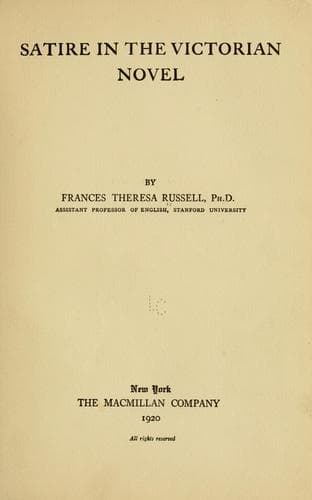
Satire in the Victorian novelRussell, Frances Theresa
History
Satire in the Victorian novel
Russell, Frances Theresa
English fiction -- 19th century -- History and criticism; Satire, English -- History and criticism; Thesis (Ph. D.)
In character we have a range from the vulgar, vigorous sarcasm of
Mr. Panks[195] to the languid patrician banter of Sir John Chester,
exercised on the uncomprehending Sim Tappertit and Gabriel Varden.
There are also ironic touches in the two heroes, Martin Chuzzlewit and
David Copperfield.
The most delightful pictures of those who entertain irony unaware are
Mr. Bumble, Mr. Squeers, Mr. Turveydrop, Mrs. Skewton, Mrs. Nickleby,
and Mrs. Pardiggle.
Entrenched in wisdom, these philosophers all enunciate profound truths
about life.
The beadle discovers the illimitable vistas of human desires, together
with the unreasonable expectation of having them gratified. He laments
the ingratitude of the pauper who, in antiparochial weather, having
been granted bread and cheese, has the audacity to ask for a bit of
fuel.[196]
“That’s the way with these people, ma’am; give ’em a apron full
of coals today, and they’ll come back for another, the day after
tomorrow, as brazen as alabaster.”
The pedagogue learns that parental prejudice sometimes extends to
an extravagant pampering of offspring, even carried so far as an
absurd opposition to wholesome discipline. Summoned to London on some
bothering law business for what was called the neglect of a boy, he
explains to the sympathetic Ralph Nickleby that the lad had as good
grazing as there was to be had.[197]
“When a boy gets weak and ill and don’t relish his meals, we
give him a change of diet--turn him out, for an hour or so
every day, into a neighbor’s turnip-field, or sometimes, if
it’s a delicate case, a turnip-field and a piece of carrots
alternately, and let him eat as many as he likes. There an’t
better land in the county than this perwerse lad grazed on, and
yet he goes and catches cold and indigestion and what not, and
then his friends brings a lawsuit against _me_!”
The Professor of Deportment, not subject to these sordid contacts,
inhales a more rarified atmosphere, and recognizes the value of a
_succes d’estime_, sufficient to compensate for neglect on the part of
a stupid public.[198]
“It may not be for me to say that I have been called, for some
years now, Gentleman Turveydrop; or that His Royal Highness,
the Prince Regent, did me the honour to inquire, on my removing
my hat as he drove out of the Pavilion at Brighton (that fine
building), ‘Who is he? Who the devil is he? Why don’t I know
him? Why hasn’t he thirty thousand a year?’ But these are
little matters of anecdote--the general property, ma’am,--still
repeated, occasionally, among the upper classes.”
The contributions of the ladies seem to be along psychological rather
than social or sociological lines. Mrs. Nickleby is plaintively aware
of the thistle-ball nature of the masculine mind, fixed by no friendly
star, though the star was not wanting. She discerns on the part of her
son a certain inattentiveness to her remarks.[199]
Public-domain text, read in full here on John Shaqi.
Reviews
Reviews
No reviews yet
Be the first to share your thoughts on this work.
Elsewhere in the archive
Join the Discussion
Join the discussion
Sign in to leave a comment or review.
Sign InorCreate an account