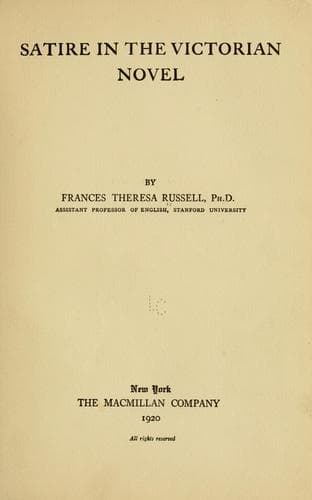
Satire in the Victorian novelRussell, Frances Theresa
History
Satire in the Victorian novel
Russell, Frances Theresa
English fiction -- 19th century -- History and criticism; Satire, English -- History and criticism; Thesis (Ph. D.)
Less cheerful and more sardonic is the smile with which Butler greets
life and its follies. He is classed with Peacock as a romanticist in
method, but is more akin to Swift in temper and manner than to any
Victorian. The reader’s mind must be kept taut in the constant process
of translating the assumed pose into the real meaning. Under the grave
disapproval of the Erewhonian treatment of disease or any misfortune,
and crime, each being discussed in the terms we apply to the other,
lurks the reversed judgment. Nothing short of complete presentation,
especially of the chapters on Current Opinions, Some Erewhonian
Trials, The Musical Banks, and The Colleges of Unreason, could convey
an adequate impression.
A representative sample, however, is found in the retort of the judge
who pronounces sentence on the youth “charged with having been swindled
out of a large property during his minority by his guardian.” The
defendant puts up the plea natural under the circumstances, and is
promptly instructed not to talk nonsense:[212]
“People have no right to be young, inexperienced, greatly in awe
of their guardians, and without independent professional advice.
If by such indiscretions they outrage the moral sense of their
friends, they must expect to suffer accordingly.”
Later a thorough exposition of this legal philosophy is given in a
long judicial oration preceding the doom of a prisoner found guilty
of pulmonary consumption. A few excerpts show the trend of the
argument.[213]
“It is all very well for you to say that you came of unhealthy
parents, and had a severe accident in your childhood which
permanently undermined your constitution; excuses such as these
are the ordinary refuge of the criminal; but they cannot for one
moment be listened to by the ear of justice. * * * There is no
question of how you came to be wicked, but only this--namely,
are you wicked or not? * * * It is intolerable that an example
of such terrible enormity should be allowed to go at large
unpunished. Your presence in the society of respectable people
would lead the less able-bodied to think more lightly of all
forms of illness; * * * A time of universal dephysicalization
would ensue; medicine vendors of all kinds would abound in our
streets and advertise in all our newspapers. * * * If you tell
me that you had no hand in your parentage and education, * * * I
answer that whether your being in a consumption is your fault or
no, it is a fault in you, and it is my duty to see that against
such faults as this the commonwealth shall be protected. You may
say that it is your misfortune to be criminal; I answer that it
is your crime to be unfortunate.”
This is a fit successor to the marvelous “Let no man” conclusion to the
_Modest Proposal_.
Public-domain text, read in full here on John Shaqi.
Reviews
Reviews
No reviews yet
Be the first to share your thoughts on this work.
Elsewhere in the archive
Join the Discussion
Join the discussion
Sign in to leave a comment or review.
Sign InorCreate an account