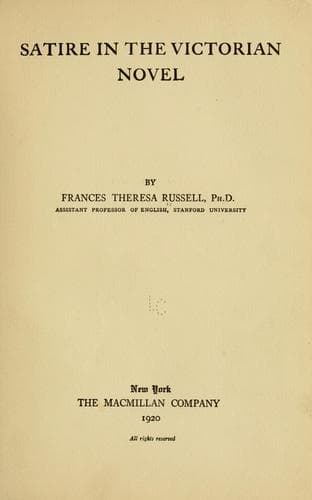
Satire in the Victorian novelRussell, Frances Theresa
History
Satire in the Victorian novel
Russell, Frances Theresa
English fiction -- 19th century -- History and criticism; Satire, English -- History and criticism; Thesis (Ph. D.)
“But a handsome woman at the head of your table, who knows
how to dress and how to sit, and how to get in and out of her
carriage--who will not disgrace her lord by her ignorance, or
fret him by her coquetry, or disparage him by her talent--how
beautiful a thing it is! For my own part I think that Griselda
Grantly was born to be the wife of a great English peer.”
It is comforting to know that in the midst of these lofty circles the
daughter of the archdeacon did not lose the virtue of humility; for we
read in a subsequent narrative:[208]
“But, now and again, since her august marriage, she had laid her
coronated head upon one of the old rectory pillows for a night
or two, and on such occasions all the Plumsteadians had been
loud in praise of her condescension.”
The difference between the novelists just discussed and the remaining
half of the list, in the use of irony, is more easily perceived than
defined. It can only be suggested by metaphor. Confectionery may be
flavored, for instance with citron in lumps or liquid peppermint.
It is evident that the former is more visible and detachable, but
that the latter affects more pervasively the quality of the product.
In the concoctions already mentioned, from Lytton to Trollope, it
is easy enough to stick in one’s thumb and pull out a plum. All the
plums being pulled out, the character of the remaining portion would
not be radically changed. But peppermint cannot be extracted except
by a process of chemical dissolution; and if it could, the taste of
the whole would be altered. Yet it is not patent to eye or finger,
though not wanting in stimulus to other senses. These two ingredients,
however, are not mutually exclusive. The permeated may also be
sufficiently glomerate to permit of some dissection; only the operation
is less fully explanatory of the whole.
For example, we may extract from Peacock his description of the Abbey
of Rubygill, situated--[209]
“* * * in a spot which seemed adapted by nature to be the
retreat of monastic mortification, being on the banks of a fine
trout-stream, and in the midst of woodland coverts, abounding
with excellent game.”
Or of the sword of Matilda, which went--[210]
“* * * nigh to fathom even that extraordinary depth of brain
which always by divine grace furnishes the interior of a
head-royal.”
Or the reply of Mr. Cypress to Dr. Folliott’s statement of the
Brotherhood of Man:[211]
“Yes, sir, as the hangman is of the thief; the squire of the
poacher; the judge of the libeller; the lawyer of his client;
the statesman of his colleague; the bubble-blower of the
bubble-buyer; the slave-driver of the negro: as these are
brethren, so am I and the worthies in question.”
But this would give little idea of Peacock’s prevailing attitude,--a
cheerfully sardonic amusement at the state of human affairs, expressed
most frequently by means of an ironic juxtaposition of Past and Present.
Public-domain text, read in full here on John Shaqi.
Reviews
Reviews
No reviews yet
Be the first to share your thoughts on this work.
Elsewhere in the archive
Join the Discussion
Join the discussion
Sign in to leave a comment or review.
Sign InorCreate an account