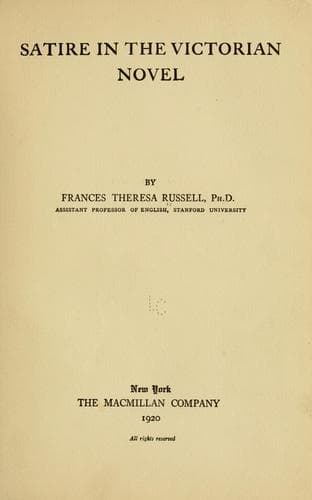
Satire in the Victorian novelRussell, Frances Theresa
History
Satire in the Victorian novel
Russell, Frances Theresa
English fiction -- 19th century -- History and criticism; Satire, English -- History and criticism; Thesis (Ph. D.)
Thackeray is placed in the group of dyed-in-the-wool ironists mainly
because he does not belong in the other. One somehow acquires the
impression that ironic sayings will be plentiful as blackberries; but
when one actually goes berrying, he finds the crop strangely vanished.
Lacking the grave, dry, imperturbable manner and the consistently
preserved attitude, he cannot avoid the temptation of relapsing into
the literal and giving self-conscious explanations, as in _Barry
Lyndon_, and _Catherine_. This produces something of the effect of
Lydgate’s ironic titles,--_So as the Crabbe goeth forward_, and _As
Straight as a Ram’s Horn_,--followed by perfectly serious moralizing.
Probably nothing would astonish or distress Thackeray more than to have
his humor rated as the humor of Lytton, Reade, or Kingsley; nor would
this indeed be quite fair to him. Yet his lack of real spontaneity
classifies him with them rather than with Dickens or Trollope, and
his lack of finish and subtlety prevents him from being ranked with
Peacock, Eliot, Meredith or Butler. His ironic phrasing has too often
the flat, shallow sound of the man determined to be clever. Such, for
instance, is the comment on the plutocratic Miss Crawley:[216]
“She had a balance at the banker’s which would have made her
beloved anywhere. * * * What a dignity it gives an old lady,
that balance at the banker’s!”
Such also is this demolishing assault upon worldliness:[217]
“I, for my part, have known a five pound note to interpose and
knock up a half century’s attachment between two brethren; and
can’t but admire, as I think what a fine and durable thing Love
is among worldly people.”
And this upon a shoddy _noblesse oblige_:[218]
“I admire that admiration which the genteel world sometimes
extends to the commonalty. There is no more agreeable object in
life than to see May Fair folks condescending.”
When he gravely admonishes, it is as follows:[219]
“Praise everybody, I say to such; never be squeamish, but speak
out your compliment both point blank to a man’s face, and behind
his back, when you know there is a reasonable chance of his
hearing it again.”
The direct satire on Pitt Crawley as an undergraduate is given an
ironic fillip by another sting in the tail:[220]
“But though he had a fine flux of words, and delivered his
little voice with great pomposity and pleasure to himself, and
never advanced any sentiment or opinion which was not perfectly
trite and stale, and supported by a Latin quotation; yet he
failed somehow, in spite of a mediocrity which ought to have
insured any man a success.”
Another successful bit,--this time the device of catching an unwary
character in an ironic trap,--is the account of Penn’s linguistic
proficiency. His friend Strong compliments him on speaking French like
Chateaubriand,--[221]
Public-domain text, read in full here on John Shaqi.
Reviews
Reviews
No reviews yet
Be the first to share your thoughts on this work.
Elsewhere in the archive
Join the Discussion
Join the discussion
Sign in to leave a comment or review.
Sign InorCreate an account