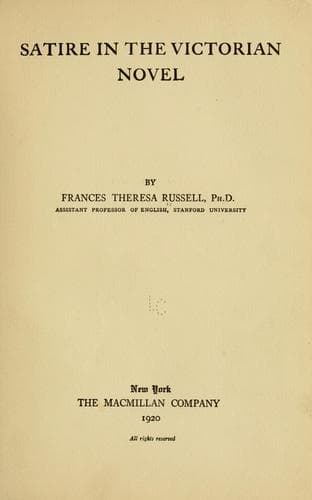
Satire in the Victorian novelRussell, Frances Theresa
History
Satire in the Victorian novel
Russell, Frances Theresa
English fiction -- 19th century -- History and criticism; Satire, English -- History and criticism; Thesis (Ph. D.)
“‘I’ve been accustomed to it from my youth upwards,’ said Pen;
and Strong had the grace not to laugh for five minutes, when he
exploded into fits of hilarity which Pen has never, perhaps,
understood up to this day.”
In her preface to the second edition of _Jane Eyre_, Charlotte
Brontë said that Thackeray resembled Fielding “as an eagle does a
vulture;” and also compared the former to a Hebrew prophet. Putting
aside the injustice to Fielding (happily atoned for by the author of
_Middlemarch_, thereby restoring the average in feminine criticism)
one is moved to reply that if any Victorian shoulders received the
mantle of Elijah they were undoubtedly the firm-muscled ones of George
Eliot. Hers is the union of native, smoldering wit and tremendous moral
earnestness that marked the ancient Semitic race and reappeared in the
modern Saxon. The downright seriousness which constitutes her main mood
is tinctured but lightly with the ironic tone, but its pungency is well
distributed. Its appearance is characterized by brevity and frequency.
There are no long passages of sustained irony; and no very long ones
wholly devoid of it. It usually occurs in quiet, unostentatious
phrases, as in the description of the Raveloe philosophy, or of that
superior family whose daughters bloomed into the Mesdames Deane, Glegg,
Pullet, and Tulliver.
The cogitative Mr. Glegg, for instance, had a truly scientific attitude
toward the captious temper that enlivened his home,--[222]
“* * * it is certain that an acquiescent mild wife would have
left his meditations comparatively jejune and barren of mystery.”
Mrs. Waule, on the other hand, was an acquiescent mild soul, and
accepted domestic frankness as in the order of nature,--[223]
“Indeed, she herself was accustomed to think that entire freedom
from the necessity of behaving agreeably was included in the
Almighty’s intentions about families.”
From this banter we pass to a bitter sarcasm that covers a burning
social sympathy in the account of the Florentine banquet, where
none could eat the tough, expensive peacock, but all gloried in the
extravagance of having it to play with,--[224]
“And it would have been rashness to speak slightingly of
peacock’s flesh, or any other venerable institution at a time
when Fra Girolamo was teaching the disturbing doctrine that it
was not the duty of the rich to be luxurious for the sake of the
poor.”
Irony is applied to two young men, with totally different purposes;
in one case it is directed against the youth himself; in the other,
against an anticipated criticism of his conduct.
Fred Vincy belongs to the class of which Algernon Blancove is the most
brilliant representative, and from which Evan Harrington made an early
escape. He is persuaded that he “wouldn’t have been such a bad fellow
if he had been rich.” But his destiny induces in him “a streak of
misanthropic bitterness.”[225]
Public-domain text, read in full here on John Shaqi.
Reviews
Reviews
No reviews yet
Be the first to share your thoughts on this work.
Elsewhere in the archive
Join the Discussion
Join the discussion
Sign in to leave a comment or review.
Sign InorCreate an account