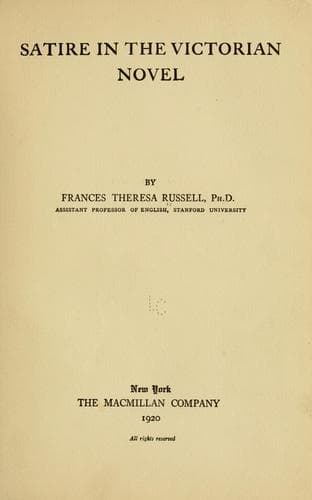
Satire in the Victorian novelRussell, Frances Theresa
History
Satire in the Victorian novel
Russell, Frances Theresa
English fiction -- 19th century -- History and criticism; Satire, English -- History and criticism; Thesis (Ph. D.)
Any study, therefore, which tries to deal with satire as a mode rather
than a form will profit by using the adjective instead of the noun.
Without fully accepting the erasure of the old literary boundaries
advocated by Croce, Spingarn, and the modern school, we may say that
in this particular field at least, the substitution of the descriptive
_satiric_ for the categoric _satire_ shows that discretion which is
the better part of valor. Still, since to avoid the responsibility
of deciding whether or not a given production is a satire, by the
non-committal device of calling it satiric, is only to beg the question
so far as a definition is concerned, it is advisable to produce some
identifying label. Stated in brief, satire is humorous criticism of
human foibles and faults, or of life itself, directed especially
against deception, and expressed with sufficient art to be accounted as
literature.
When we say, however, that satire is a union of those two intangible,
subjective elements, criticism and humor, we do not assume the equation
fully to be expressed by the formula--Antagonism plus Amusement equals
Satire. For neither is all criticism humorous nor all humor critical.
The relation is that of two circles, not coincident but overlapping.
[Illustration]
Confusion has arisen because, while the boundaries of the two separate
circles are fairly distinct in our minds, the circumference made by
their conjunction is merged in their respective planes. Accordingly,
the term satire is sometimes used to denote humorless criticism,--which
is really invective, denunciation, any sort of reprehension; and
sometimes uncritical humor,--which is mere facetiousness and
jocularity. Not every prophet, preacher, or pedagogue is a satirist,
nor yet every merry clown, or exuberant youth, or mild worldly-wise man
enjoying the blunders of innocent naïveté.
Professor Dewey reminds us that the ideal state of mind is “a nice
balance between the playful and the serious.” But in the satiric
circle a nice balance would be found only at the center. Wherever there
are boundaries, there are always some sections of the enclosure nearer
the margin than others. Thus, although satire is a compound, it does
not follow that its fractions stand in a constant uniform ratio. On the
contrary, the proportion ranges all the way from a minimum of humor in
a Juvenal or a Johnson to a minimum of criticism in a Horace, a Gay,
or a Lamb. Either quality may reach the vanishing point, but when it
passes it, the remaining one cannot alone create satire, any more than
oxygen or hydrogen can be transformed into water.
Public-domain text, read in full here on John Shaqi.
Reviews
Reviews
No reviews yet
Be the first to share your thoughts on this work.
Join the Discussion
Join the discussion
Sign in to leave a comment or review.
Sign InorCreate an account