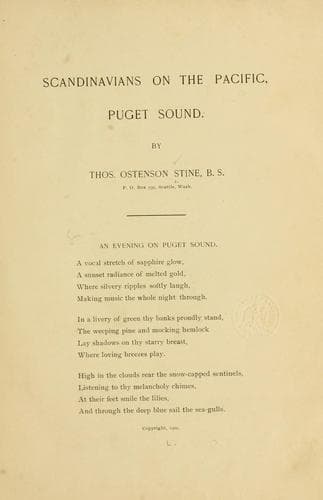
Scandinavians on the Pacific, Puget SoundStine, Thomas Ostenson
History
Scandinavians on the Pacific, Puget Sound
Stine, Thomas Ostenson
Scandinavian Americans; Washington (State) -- Emigration and immigration
C. N. Sandahl.--Washington is dependent on the science of horticulture,
fruit is her future. Any man willing to bend his heart to the soil is a
valuable exponent in the upbuilding of the country. Few men have done
more in this line than the well-known floriculturist and nurseryman, C.
N. Sandahl, of 1123, Second Avenue, Seattle. He was born in Horsens,
Denmark, 1857; acquired his education in the public schools of his
fatherland, and in the smiling book of nature, where real knowledge
teems to an intelligent eye. In 1880 he emigrated to America, spent
ten years in Ohio and Minnesota, pursuing his chosen vocation, then
journeyed to Washington and located in Seattle. After a careful scrutiny
of the country he engaged in floriculture and nursery, which occupation
he is following with notable ability. Mr. Sandahl is a man of business
capacity as well as of scientific propensity, and honest and honorable.
[Illustration: S. S. LANGLAND.]
Samuel S. Langland.--Quiet of disposition but deep in thought, modest
in demeanor but aggressive in argument. The above words unfold Mr.
Langland's characteristic, an able lawyer of Seattle. He was born near
Stavanger, Norway, August 13, 1856, and emigrated with his parents to
Minnesota in the spring of 1867. His early boyhood experienced the
various hardships and vicissitudes incident to pioneer life. At the age
of fifteen he launched out for himself, choosing as a means of support
the apprenticeship of a tailor in Mancato, in which capacity he labored
a year and a half. From whence he went to St. Paul, a stranger in
an unwont sphere. English defied his tongue, but soon melted to his
grasping intellect. He worked at his trade about two years, but to
ascend to a higher stage of culture, he converted his energy to loftier
aims, worked for his board and attended private school, paying for his
tuition by doing janitor work, sweeping and keeping the schoolhouse
in order. After two years of assiduous study in this institution, he
entered the classical course of four years in the St. Paul High School
which he completed in three. In the fall of 1881 he was matriculated in
the same course at the state university, graduating with honor in
June, 1885. At the commencement exercises he distinguished himself by
delivering the most thoughtful and eloquent oration of the class, his
subject being "Is Man Advancing?" for which he received compliments from
the faculty and leading men of the state present on that occasion. His
struggles at the university with poverty symbolize an indomitable will.
He toiled evenings and Saturdays sawing wood and doing other manual
labor, his vacations were spent canvassing, or in the harvest field.
After darkness comes sunshine, and the year following his graduation he
was appointed professor of English Literature in the Augsburg Seminary.
In 1887 he studied law in St. Paul, was admitted to bar, and practiced
for some time at Moorhead, Minnesota, where he made rapid progress, being
Public-domain text, read in full here on John Shaqi.
Reviews
Reviews
No reviews yet
Be the first to share your thoughts on this work.
Join the Discussion
Join the discussion
Sign in to leave a comment or review.
Sign InorCreate an account