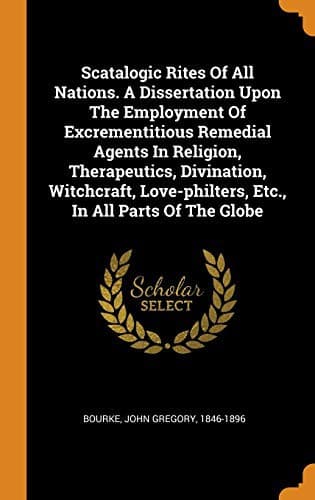
Scatalogic Rites of All Nations: A dissertation upon the employment of excrementitious remedial agents in religion, therapeutics, divination, witchcraft, love-philters, etc., in all parts of the globeBourke, John Gregory
Religion
Scatalogic Rites of All Nations: A dissertation upon the employment of excrementitious remedial agents in religion, therapeutics, divination, witchcraft, love-philters, etc., in all parts of the globe
Bourke, John Gregory
Scatology
“When they ease themselves, they commonly go in the morning unto the
Towne’s end, where there is a place purposely made for them, that they
may not bee seene, so also because men passing by should not be molested
with the smell thereof. They also esteeme it a bad thing that men should
ease themselves upon the ground, and therefore they make houses which are
borne up above the ground, wherein they ease themselves upon the ground,
and every time they do it they wipe; or else they goe to the water’s side
to ease themselves in the sand; and when the Priuie houses are full, they
set fire to them, and let them burn to ashes; they pisse by jobs as dogs
doe, and not all at one time.”—(Master Richard Jobson, A.D. 1620, “Gold
Coast of Africa,” in Purchas, vol. ii. p. 932.)
XXI.
AN INQUIRY INTO THE NATURE OF THE RITES CONNECTED WITH THE WORSHIP OF
BEL-PHEGOR.
Precisely what ceremonial observances the ritual of Bel-Phegor demanded
of the suppliant at his shrine is not likely ever to be known. It would
be worse than useless to attempt in a treatise of this kind to affirm or
deny the existence of the obscene usages alleged to have formed part of
his worship; sufficient, at this moment, to lay before reflecting minds
testimony on both sides of the question, with reasons for the belief that
flatulence could be presented as an oblation, with examples of quaint
customs which may partake of the nature of “survivals” from religious
ceremonies of a nature not far removed from those supposed to have been
associated with the rites of Bel-Phegor.
Well has an old author remarked: “Men have lost their reason in nothing
so much as their religion, wherein stones and clouts make martyrs; and
since the religion of one seems madness to another, to afford an account
or rational of old rites requires no rigid reader.”—(Sir Thomas Browne,
“Religio Medici,” edition of Boston, 1868, p. 329, article “Urn-Burial.”)
“Le Pet était une divinité des anciens Égyptiens; elle était la
personnification d’une fonction naturelle. On la figurait par un enfant
accroupi qui semble faire effort, et on peut en voir la représentation
dans les ouvrages d’antiquité. Le poême Calotin, intitulé le Conseil de
Momus (voyez aux Polygraphes) donne, contre la page 19, deux figures de
ce dieu. L’une était en cornaline de trois couleurs; l’autre en terre
cuite, se trouvait dans le cabinet du Marquis de Cospy, et la figure
en a été donnée dans le Museum Cospianum. L’auteur de la Dissertation
sur un ancien Usage (voyez le numéro 18) conteste que ces figurines se
rapportent au Crepitus, et croit qu’elles ont été inventées dans un but
plus solide.
Public-domain text, read in full here on John Shaqi.
Reviews
Reviews
No reviews yet
Be the first to share your thoughts on this work.
Elsewhere in the archive
Join the Discussion
Join the discussion
Sign in to leave a comment or review.
Sign InorCreate an account