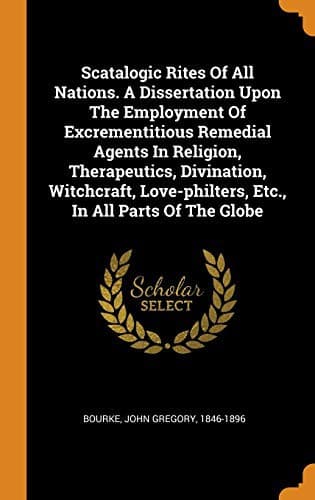
Scatalogic Rites of All Nations: A dissertation upon the employment of excrementitious remedial agents in religion, therapeutics, divination, witchcraft, love-philters, etc., in all parts of the globeBourke, John Gregory
Religion
Scatalogic Rites of All Nations: A dissertation upon the employment of excrementitious remedial agents in religion, therapeutics, divination, witchcraft, love-philters, etc., in all parts of the globe
Bourke, John Gregory
Scatology
“Après la messe, chacun couroit, sautoit et dansoit par l’église avec
tant d’impudence, que quelques uns n’àvoient pas honte de se porter à
toutes sortes d’indécences et de se dépouillier entièremênt; ensuite, ils
se faisoìent trainer par les rues dans des tombereaux pleins d’ordures,
d’ou ils prenoient plaisir d’en jeter à la populace qui s’assembloit
autour d’eux.
“Ils s’arrétoient et faisoient de leurs corps des mouvements et des
postures lascives qu’ils accompagnoient de paroles impudiques.
“Les plus impudiques d’entre les séculiers se mêloient parmi le clergé,
pour faire aussi quelques personnages de Foux en habits ecclésiastiques
de Moines et de Religieuses.”—(Picart, “Coûtumes et Cérémonies
réligieuses de toutes les Nations du Monde,” Amsterdam, Holland, 1729,
vol. ix. pp. 5, 6).
Diderot and d’Alembert use almost the same terms; the officiating clergy
were clad “les uns comme des bouffons, les autres en habits de femmes ou
masqués d’une façon monstrueuse ... ils mangeaient et jouaient aux dés
sur l’autel à côté du prêtre qui célébroit la messe. Ils mettoient des
ordures dans les encensoirs.” They say that the details would not bear
repetition. This feast prevailed generally in Continental Europe from
Christmas to Epiphany, and in England, especially in York.—(Diderot and
D’Alembert, Encyclopædia, “Fête des Fous,” Geneva, Switzerland, 1779.)
Markham discovers a resemblance between the “Monk of Misrule” of
Christendom in the Middle Ages, and “Gylongs dressed in parti-colored
habits ... singing and dancing before the Teshu Lama in Thibet.”—(See
Markham’s “Thibet,” London, 1879, page 95, footnote. See also Bogle’s
description of the ceremonies in connection with the New Year, in
presence of the Teshu Lama, in Markham’s “Thibet,” p. 106.)
The Mandans had an annual festival one of the features of which was “the
expulsion of the devil.... He was chased from the village ... the women
pelting him with dirt.”—(“The Golden Bough,” Frazer, London, 1890, vol.
ii. p. 184, quoting Catlin’s “North American Indians,” page 166.)
The authors who have referred at greater or less length, and with more
or less preciseness, to the Feast of Fools, Feast of Asses, and others
of that kind, are legion; unfortunately, without an exception, they
have contented themselves with a description of the obscene absurdities
connected with these popular religious gatherings, without attempting an
analysis of the underlying motives which prompted them, or even making an
intelligent effort to trace their origin. Where the last has been alluded
to at all, it has almost invariably been with the assertion that the
Feast of Fools was a survival from the Roman Saturnalia.
Public-domain text, read in full here on John Shaqi.
Reviews
Reviews
No reviews yet
Be the first to share your thoughts on this work.
Join the Discussion
Join the discussion
Sign in to leave a comment or review.
Sign InorCreate an account