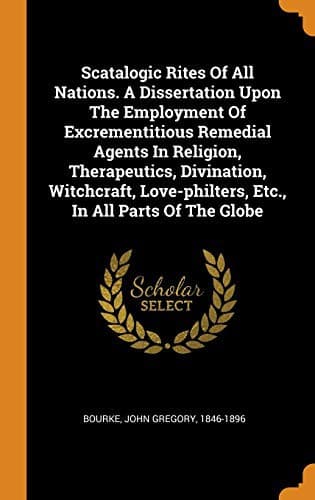
Scatalogic Rites of All Nations: A dissertation upon the employment of excrementitious remedial agents in religion, therapeutics, divination, witchcraft, love-philters, etc., in all parts of the globeBourke, John Gregory
Religion
Scatalogic Rites of All Nations: A dissertation upon the employment of excrementitious remedial agents in religion, therapeutics, divination, witchcraft, love-philters, etc., in all parts of the globe
Bourke, John Gregory
Scatology
Cat-dung, in wine, formed the remedy in cases of vertigo and epilepsy.
While its use was recommended principally in external applications, there
were not wanting those who relied upon it mainly in internal application.
It was reputed to possess especial efficacy in loss of hair, and supposed
to be serviceable in preventing baldness, applied as an unguent.
Administered internally, it suppressed immoderate menstrual flow. For the
cure of felons, which so many in those days believed to be occasioned by
a small worm, it was of certain efficacy, if bound round the afflicted
thumb or finger. Paullini is quoted as having had personal experience
with felons thus cured. But Paullini himself was of opinion that the dung
of the goose was of equal value with that of the cat in this case (p.
815).
Hen-dung was recommended for use in burns. It was regarded as beneficial
against magic philters, “in specie ex sanguine menstruo fœmineo.” It
was considered good for all those ailments for which dove-dung was
prescribed, but was not quite so efficacious. It was excellent for colic,
for uterine pangs, yellow jaundice, calculus, suppression of urine, for
all pains in the bowels, for strangling of the womb and pains therein,
for poison, witchcraft, for seat-worms, etc. Externally, it was applied
for all sores in the eyes, ulcers, warts, cicatrices, piles, pains in the
feet and arms (pp. 816, 817).
Swallow-dung is mentioned as of internal and external application. It was
regarded of great efficacy in the treatment of mad-dog bites, quaternary
fevers, colic, inflammation of the kidneys, etc. It was applied as a
plaster in cases of headache, angina, inflammation of the tonsils, and
as a suppository in relaxation of the rectum. Its efficacy was conceded
in dyeing the hair, being invaluable when used frequently as an unguent.
Etmuller is quoted as expressing the opinion that they owe their action
to the presence of “Armoniacal” salts. The swallow’s nest, with all its
contents, was also sometimes ground up into a plaster, and swallow-dung
itself was occasionally substituted for “album Græcum” (pp. 817 _et
seq._).
Lion-dung exerted its potency in cases of difficult labor, and it was the
panacea against epilepsy and apoplexy. One of the Grand Dukes of Austria
was cured of epilepsy by its use. Preference was given to the excrement
of a female lion, except where she had just brought forth young. An
anti-epileptic remedy of great repute was composed of burnt crow’s-nest,
burnt tortoise, burnt human skulls, linden-tree bark, and lion-dung, made
into an infusion by long digestion in spirits of wine (pp. 819, 820).
Public-domain text, read in full here on John Shaqi.
Reviews
Reviews
No reviews yet
Be the first to share your thoughts on this work.
Elsewhere in the archive
Join the Discussion
Join the discussion
Sign in to leave a comment or review.
Sign InorCreate an account