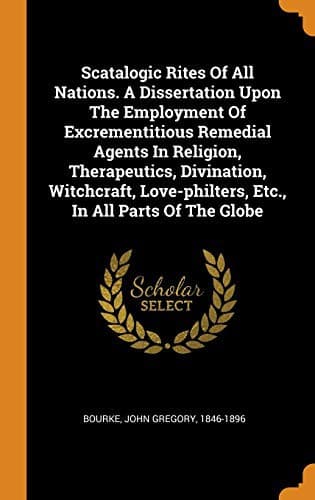
Scatalogic Rites of All Nations: A dissertation upon the employment of excrementitious remedial agents in religion, therapeutics, divination, witchcraft, love-philters, etc., in all parts of the globeBourke, John Gregory
Religion
Scatalogic Rites of All Nations: A dissertation upon the employment of excrementitious remedial agents in religion, therapeutics, divination, witchcraft, love-philters, etc., in all parts of the globe
Bourke, John Gregory
Scatology
“No subject could be more interesting than an inquiry into the origin
of the superstitions of uncivilized tribes.” (“Philosophy of Magic,”
Salverte, vol. i. p. 138.) Salverte remarks that the Fairies “were
supposed to be diminutive, aerial beings, beautiful, lively, and
beneficent in their intercourse with mortals, inhabiting a region called
Fairy Land,—Alf-Heiner,—commonly appearing on earth at intervals,
when they left traces of their visits in beautiful green rings, where
the dewy sward had been trodden in their moon-light dances.... The
investigations of science have traced these rings to a species of
fungus,—_Agaricus oreades_,—but imagination still leads us willingly back
to the traditional appearance of these diminutive beings in the train of
their queen; ... and we also behold her tiny followers dancing away the
midnight hours to the sound of the most enchanting music.”—(Idem, vol. i.
p. 138, footnote.)
There is the following memorandum in Hazlitt’s “Fairy Tales” (London,
1875, p. 35): “Mem., that pigeon’s-dung and nitre steeped in water will
make the fayry circles; it draws to it the nitre of the air, and it will
never weare out.”
“The mushroom has always been associated with fairy-lore. It is mentioned
as the fairy dining-table (p. 502); while in the list of foods partaken
of by Oberon, we read:—
“ ... with a wine,
Ne’er ravished with a clustered vine,
But gently strained from the side
Of a sweet and dainty bride;
Brought in a daizy chalice, which
He fully quaffed up to bewitch
His blood to height.”
While Robin Goodfellow is represented as singing,—
“When lads and lasses merry be,
With possets and with juncates fine,
Unseene of all the company,
I eat their cakes and sip their wine;
And to make sport,
I fart and snort,
And out the candles I do blow.”
—(Brand, Pop. Ant., London, 1872, pp. 476 _et seq._, articles “Fairy
Mythology,” and “Robin Goodfellow.”)
Herrick describes the food of fairies:—
“ ... with a wine
Ne’er ravished from the flattering vine,
But gentle prest from the soft side
Of the most sweet and dainty bride.”
—(Herrick, “Hesperides;” also quoted in Hazlitt’s “Fairy Tales,” London,
1875, p. 300.)
The “wine” just described would seem to belong, in all fairness, to the
classification of Ur-Orgies.
A careful search of Shakspeare shows that while perhaps he knew little
directly to our purpose, he still had a knowledge that we may utilize;
for example, he speaks of the “midnight mushroom,” showing that it was an
element of midnight revels of the fairies; he alludes to customs which
certainly suggest that slaves and criminals were in early days buried
beneath dung-heaps as a punishment; and he can be adduced to prove that
the epithet “dunghill” applied to a man, was a most deadly insult; but
let the bard speak for himself,—
Public-domain text, read in full here on John Shaqi.
Reviews
Reviews
No reviews yet
Be the first to share your thoughts on this work.
Elsewhere in the archive
Join the Discussion
Join the discussion
Sign in to leave a comment or review.
Sign InorCreate an account