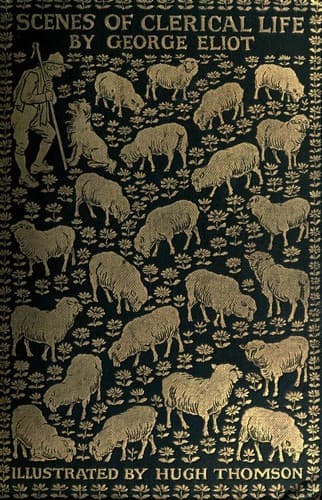
Clergy -- Fiction; England -- Social life and customs -- 19th century -- Fiction
Such as the place was, the people there were entirely contented with it.
They fancied life must be but a dull affair for that large portion of
mankind who were necessarily shut out from an acquaintance with Milby
families, and that it must be an advantage to London and Liverpool that
Milby gentlemen occasionally visited those places on business. But the
inhabitants became more intensely conscious of the value they set upon
all their advantages, when innovation made its appearance in the person
of the Rev. Mr. Tryan, the new curate, at the chapel-of-ease on Paddiford
Common. It was soon notorious in Milby that Mr. Tryan held peculiar
opinions; that he preached extempore; that he was founding a religious
lending library in his remote corner of the parish; that he expounded the
Scriptures in cottages; and that his preaching was attracting the
Dissenters, and filling the very aisles of his church. The rumour sprang
up that Evangelicalism had invaded Milby parish--a murrain or blight all
the more terrible, because its nature was but dimly conjectured. Perhaps
Milby was one of the last spots to be reached by the wave of a new
movement and it was only now, when the tide was just on the turn, that
the limpets there got a sprinkling. Mr. Tryan was the first Evangelical
clergyman who had risen above the Milby horizon: hitherto that obnoxious
adjective had been unknown to the townspeople of any gentility; and there
were even many Dissenters who considered ‘evangelical’ simply a sort of
baptismal name to the magazine which circulated among the congregation of
Salem Chapel. But now, at length, the disease had been imported, when the
parishioners were expecting it as little as the innocent Red Indians
expected smallpox. As long as Mr. Tryan’s hearers were confined to
Paddiford Common--which, by the by, was hardly recognizable as a common
at all, but was a dismal district where you heard the rattle of the
handloom, and breathed the smoke of coal-pits--the ‘canting parson’ could
be treated as a joke. Not so when a number of single ladies in the town
appeared to be infected, and even one or two men of substantial property,
with old Mr. Landor, the banker, at their head, seemed to be ‘giving in’
to the new movement--when Mr. Tryan was known to be well received in
several good houses, where he was in the habit of finishing the evening
with exhortation and prayer. Evangelicalism was no longer a nuisance
existing merely in by-corners, which any well-clad person could avoid; it
was invading the very drawing-rooms, mingling itself with the comfortable
fumes of port-wine and brandy, threatening to deaden with its murky
breath all the splendour of the ostrich feathers, and to stifle Milby
ingenuousness, not pretending to be better than its neighbours, with a
cloud of cant and lugubrious hypocrisy. The alarm reached its climax when
it was reported that Mr. Tryan was endeavouring to obtain authority from
Mr.
Public-domain text, read in full here on John Shaqi.
Reviews
Reviews
No reviews yet
Be the first to share your thoughts on this work.
Elsewhere in the archive
Join the Discussion
Join the discussion
Sign in to leave a comment or review.
Sign InorCreate an account