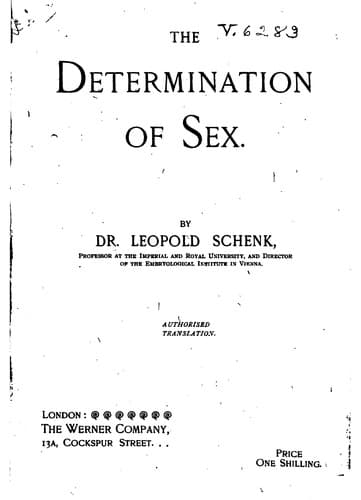
Schenk's Theory: The Determination of SexSchenk, Samuel Leopold
Science
Schenk's Theory: The Determination of Sex
Schenk, Samuel Leopold
Sex determination, Genetic; Sex preselection
We know as a universal rule that where there is rest there must be
a balance of forces. If the ovum, the accumulator of the balanced
forces in a state of rest, is to divide itself so as to produce in
this way the future individual, some stimulant impulse, some energy
is absolutely necessary to disturb the balance of forces, and to
induce the development of the cells. This impulse may be such a one as
occasions destruction. But it may also be one that gives occasion to
new growth, to tissue formation. (W. Haacke.) We must describe this
impulse as functional, and recognize in it a peculiarity which belongs
to the organic world alone, the vegetable and animal kingdom. Every
movement, every use of an organ, may serve as a stimulant impulse,
and contribute to its development. Thus we find, in the case of
great thinkers and poets, of celebrated generals, etc., a powerfully
developed brain. Oarsmen, gymnasts, and swimmers have far stronger
muscles than men who follow less fatiguing callings. In all these
cases there are impulses leading to increased growth of the organs.
In the growth of the fertilized ovum we have to deal again with a
phenomenon of impulse, a part of which is the property of the ovum
itself, a part, however, also dependent upon external influences. We
call the former autoplastic, the latter xenoplastic impulse. (Haacke.)
It is easy to understand that a purely autoplastic development (_eine
reine Autoplasie_, a pure autoplasia) cannot exist. Out of an ovum
alone, without the agency of new impulses, without the taking up of new
matter, no new individual could develop.
* * * * *
The stomach furnishes the gastric juice. It is stimulated to do so by
the food. The food is digested, undergoes absorption in the intestine,
and becomes lymph. Blood is formed. The blood passes through the
several organs and tissues, nourishes them, and replaces the substances
used up by work. As soon, therefore, as the stomach and intestine,
with the intestinal glands, fail in their functions, all the organs,
which stand in physical relation with them, suffer; because they are
constantly during their work consuming matter, and are now receiving no
fresh supplies. The case of the other juices of the body is the same.
The thyroid glands supply the body with a principle without which a
person cannot be in a normal condition. Similarly the testicles, as
glands, supply the body with a principle the want of which gives a man
distinctly female qualities, as we perceive in the case of eunuchs.
* * * * *
Public-domain text, read in full here on John Shaqi.
Reviews
Reviews
No reviews yet
Be the first to share your thoughts on this work.
Elsewhere in the archive
Join the Discussion
Join the discussion
Sign in to leave a comment or review.
Sign InorCreate an account