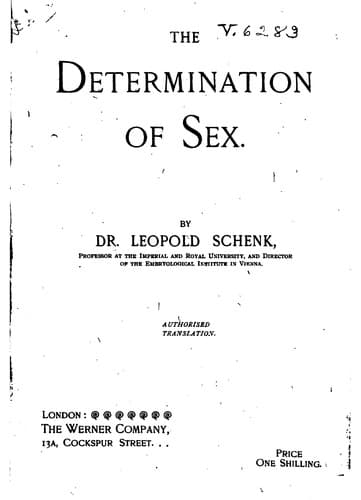
Schenk's Theory: The Determination of SexSchenk, Samuel Leopold
Science
Schenk's Theory: The Determination of Sex
Schenk, Samuel Leopold
Sex determination, Genetic; Sex preselection
Of what kind the means of impulse are, the juices are, which occasion
this I do not know. I can only supply the conditions requisite for
them; I can see only whether they are present. And so I again come
back to this, that we may expect a male individual from the ovum
when the juices are developed which serve as a functional means of
impulse for the male sex. These juices can come into existence in the
organism under the most different circumstances. But they certainly
do come into existence, if we can so feed the mother that we cannot
find in her urine even the faintest trace of sugar, but instead of
it an increased excretion of reducing substances, _accompanied by a
relatively high exchange of nitrogenous substances_. These facts can,
therefore, serve us only as a symptom of processes taking place in the
organism. In consequence our task will be to follow up in the various
cases the conditions of this symptom, _in order that we may try so to
feed the mother individual that she may attain to giving the effective
impulse_; and this we have certainly accomplished by the increased
excretion of the reducing substances and the disappearance of the
normal urine-sugar.
When we have brought a woman into such a condition that she excretes no
sugar, and by the continuation of the same diet keep her permanently
in that condition, the ovule which is being developed in her organism
will develop itself correspondingly. Also with this diet the different
qualities of the organism may not be altogether without influence on
the course of the ovum’s development.
In many cases the quantity of sugar in the urine excreted does not
diminish. The most different kinds of diet may be tried, and yet the
phenylhydrazin test will always show the presence of sugar. Individuals
of this sort exhibit a certain obstinacy in resisting the attempt to
procure an alteration of the metabolism. In such cases no influence has
been exerted over the development of the ovum.
In these experiments which are made with the mother, not only is the
ovum influenced which is being developed for fertilization in the
maternal organism, but it is also possible for the mother herself, in
consequence of the alteration of diet, to experience many changes with
regard to the physical peculiarities of the elements which compose her
body.
The treatment may prove highly beneficial to the mother herself,
so that not ovulation alone is subjected to an alteration, but the
activity of the processes of the tissues of the other organs of the
body may be also simultaneously in some way changed. And here may come
into consideration many other factors which may produce a particular
fitness for procreation and for the development of the ovum, and, if
they once make themselves felt, may be of the greatest advantage to the
mother.
Public-domain text, read in full here on John Shaqi.
Reviews
Reviews
No reviews yet
Be the first to share your thoughts on this work.
Elsewhere in the archive
Join the Discussion
Join the discussion
Sign in to leave a comment or review.
Sign InorCreate an account