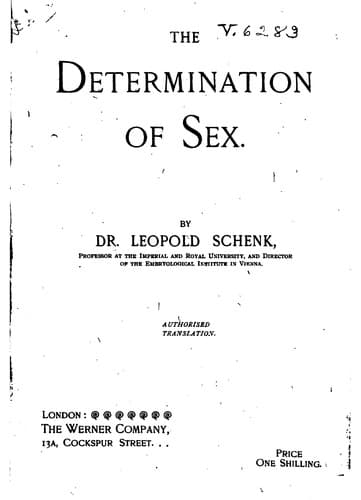
Schenk's Theory: The Determination of SexSchenk, Samuel Leopold
Science
Schenk's Theory: The Determination of Sex
Schenk, Samuel Leopold
Sex determination, Genetic; Sex preselection
The formation of the insignificant quantity of sugar in the body goes
on of itself regularly, without it being possible to perceive any
consequent striking alterations in the organism. The manner in which
sugar is formed in the body under normal conditions has in recent years
been thus explained.
The sugar contained in the blood in healthy persons is reckoned as not
higher than about 0.15 per cent. In those who suffer from diabetes it
may rise to 0.44 per cent. If sugar is present in the blood, that it
passes thence into the urine can be easily explained, seeing that the
excreted products of decomposition from the blood pass into the urine.
Thus the sugar results from a portion of the food which is transformed
into sugar, and so passes into the portal vein. (Strümpell.)
There exists also in the liver and muscles a non-nitrogenous substance,
glycogen, which is detected also in other organs. This glycogen
probably arises partly from the carbo-hydrates of the food, but
certainly from the albuminous substances taken with the food, which,
when broken up, separate into nitrogenous products and glycogen.
When the glycogen is once formed, we may regard it as an intermediate
substance which is changed into sugar, probably by a saccharine
fermentation, and then can reach the blood. How glycogen is transformed
into sugar within the organism is unknown. Normally occurring sugar
results from glycogen.
CHAPTER III
When, years ago, my attention was first attracted by the idea that,
for the solution of our problem, we ought to turn our attention to the
sugar in normal urine, no very exact tests for sugar were possible.
The reactions were not very sensitive, the fact being that the surest
evidence of the presence of sugar was obtained not from the reduction
processes but from the method used by Brücker for preparing a potassium
compound of sugar.
Every investigation which I undertook in his times for the confirmation
of my theory was very arduous. The few cases which I at first had under
observation presented formidable difficulties. The occasion of my first
turning my attention to sugar in the urine was a case of a woman who
had borne five children, and, after violent and continuous mental
excitement, was suddenly seized with diabetes mellitus. I frequently
examined her urine, and always found an abnormal amount of sugar. She
had twice given birth to children whilst suffering from diabetes, and
on each occasion the child was a female. This fact struck me, because
previously, whilst she was strong and well, she had borne sons only.
But, on the appearance of the disease mentioned, she had two daughters
in succession, of whom the first one lived and the other was still-born.
Public-domain text, read in full here on John Shaqi.
Reviews
Reviews
No reviews yet
Be the first to share your thoughts on this work.
Elsewhere in the archive
Join the Discussion
Join the discussion
Sign in to leave a comment or review.
Sign InorCreate an account