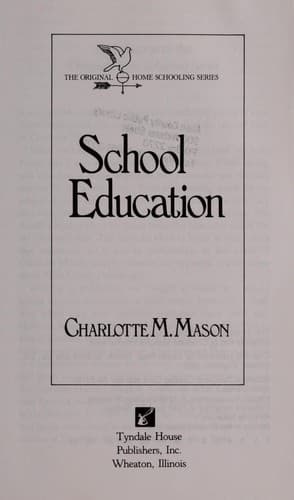
School educationMason, Charlotte M. (Charlotte Maria)
Philosophy
School education
Mason, Charlotte M. (Charlotte Maria)
Education -- Curricula; Education -- Philosophy
=Language.=—In Language, by twelve, they should have a fair knowledge
of English grammar, and should have read some literature. They should
have more or less power in speaking and understanding French, and
should be able to read a fairly easy French book; the same with German,
but considerably less progress; and in Latin, they should be reading
‘Fables,’ if not ‘Cæsar,’ and perhaps ‘Virgil.’
=Mathematics.=—I need not touch upon the subject of Mathematics. It is
receiving ample attention, and is rapidly becoming an instrument for
living teaching in our schools.
‘=Practical Instruction.=’—To turn to the question of practical
instruction, under the heads of ‘Science, Drawing, Manual and Physical
Training,’ etc., I can do no more here than repeat our convictions. We
believe that education under these four heads is due to every child of
whatever class; and, for boys and girls under twelve, probably the same
general curriculum would be suitable for all. I have nothing to add to
the sound ideas as to the teaching of each of these subjects which are
now common property.
=Science.=—In _Science_, or rather, nature study, we attach great
importance to _recognition_, believing that the power to recognise and
name a plant or stone or constellation involves classification and
includes a good deal of knowledge. To know a plant by its gesture and
habitat, its time and its way of flowering and fruiting; a bird by its
flight and song and its times of coming and going; to know when, year
after year, you may come upon the redstart and the pied fly-catcher,
means a good deal of interested observation, and of, at any rate, the
material for science. The children keep a dated record of what they
see in their nature note-books, which are left to their own management
and are not corrected. These note-books are a source of pride and joy,
and are freely illustrated by drawings (brushwork) of twig, flower,
insect, etc. The knowledge necessary for these records is not given
in the way of teaching. On one afternoon in the week, the children (of
the Practising School) go for a ‘nature walk’ with their teachers. They
notice for themselves, and the teacher gives a name or other information
as it is asked for, and it is surprising what a range of knowledge a
child of nine or ten acquires. The teachers are careful _not_ to make
these nature walks an opportunity for scientific instruction, as we wish
the children’s attention to be given to observation with very little
direction. In this way they lay up that store of ‘common information’
which Huxley considered should precede science teaching; and, what is
much more important, they learn to know and delight in natural objects
as in the familiar faces of friends. The nature-walk should not be made
the occasion to impart a sort of _Tit-Bits_ miscellany of scientific
information. The study of science should be pursued in an ordered
sequence, which is not possible or desirable in a walk. It seems to me a
Public-domain text, read in full here on John Shaqi.
Reviews
Reviews
No reviews yet
Be the first to share your thoughts on this work.
Elsewhere in the archive
Join the Discussion
Join the discussion
Sign in to leave a comment or review.
Sign InorCreate an account