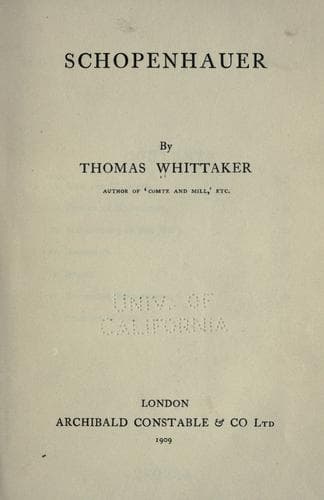
The first proposition of Schopenhauer's philosophical system is, 'The
world is my presentation.' By this he means that it presents itself as
appearance to the knowing subject. This appearance is in the forms of
time, space and causality. Under these forms every phenomenon
necessarily appears, because they are _a priori_ forms of the subject.
The world as it presents itself consists entirely of phenomena, that is,
appearances, related according to these forms. The most fundamental form
of all is the relation between object and subject, which is implied in
all of them. Without a subject there can be no presented object.
Schopenhauer is therefore an idealist in the sense in which we call
Berkeley's theory of the external world idealism; though the expressions
used are to some extent different. The difference proceeds from his
following of Kant. His Kantianism consists in the recognition of _a
priori_ forms by which the subject constructs for itself an 'objective'
world of appearances. With Berkeley he agrees as against Kant in not
admitting any residue whatever, in the object as such, that is not
wholly appearance. But while he allows that Berkeley, as regards the
general formulation of idealism, was more consistent than Kant, he finds
him, in working out the principle, altogether inadequate. For the modern
mind there is henceforth no way in philosophy except through Kant, from
whom dates the revolution by which scholastic dualism was finally
overthrown. Kant's systematic construction, however, he in effect
reduces to very little. His is a much simplified 'Apriorism.' While
accepting the 'forms of sensible intuition,' that is, time and space,
just as Kant sets them forth, he clears away nearly all the superimposed
mechanism. Kant's 'Transcendental AEsthetic,' he says, was a real
discovery in metaphysics; but on the basis of this he for the most part
only gave free play to his architectonic impulse. Of the twelve
'categories of the understanding,' which he professed to derive from the
logical forms of judgment, all except causality are mere 'blind
windows.' This alone, therefore, Schopenhauer adopts; placing it,
however, not at a higher level but side by side with time and space,
Kant's forms of intuition. These three forms, according to Schopenhauer,
make up the understanding of men and animals. 'All intuition is
intellectual.' It is not first mere appearance related in space and
time, and waiting for understanding to organise it; but, in animals as
in man, it is put in order at once under the three forms that suffice to
explain the knowledge all have of the phenomenal world.
Public-domain text, read in full here on John Shaqi.
Reviews
Reviews
No reviews yet
Be the first to share your thoughts on this work.
Join the Discussion
Join the discussion
Sign in to leave a comment or review.
Sign InorCreate an account