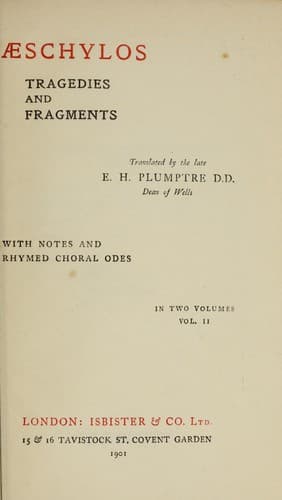
Aeschylus -- Translations into English; Mythology, Greek -- Drama
The “mighty bird of Zeus” seems here, from the answer of the Chorus,
to mean not the “eagle” but the “sun,” which roused men from their
sleep as the cock did, so that “cockcrow” and “sunrise” were
synonymous. It is, in any case, striking that Zeus, rather than
Apollo, appears as the Sun-God.
Footnote 224:
The words refer to the myth of Apollo's banishment from heaven and
servitude under Admetos.
Footnote 225:
In the Acropolis at Athens the impress of a trident was seen on the
rock, and was believed to commemorate the time when Poseidon had
claimed it as his own by setting up his weapon there. Something of the
same kind seems here to be supposed to exist at Argos, where a like
legend prevailed.
Footnote 226:
The Hellenic Hermes is distinguished from his Egyptian counterpart,
Thoth, as being different in form and accessories.
Footnote 227:
A possible reference to the Egyptian Osiris, as lord or judge of
Hades. Comp. v. 145.
Footnote 228:
“Shall I,” the Chorus asks, “speak to you as a private citizen, or as
a herald, or as a king?”
Footnote 229:
It would appear from this that the king himself bore the name
Pelasgos. In some versions of the story he is so designated.
Footnote 230:
The lines contain a tradition of the wide extent of the old Pelasgic
rule, including Thessalia, or the Pelasgic Argos, between the mouths
of Peneus and Pindos, Perrhæbia, Dodona, and finally the Apian land or
Peloponnesos.
Footnote 231:
The true meaning of the word “Apian,” as applied to the Peloponnesos,
seems to have been “distant.” Here the myth is followed which
represented it as connected with Apis the son of Telchin (son of
Apollo, in the sense of being a physician-prophet), who had freed the
land from monsters.
Footnote 232:
The description would seem to indicate—(1) that the daughter of Danaos
appeared on the stage as of swarthy complexion; and (2) that Indians,
Æthiopians, Kyprians, and Amazons, were all thought of as in this
respect alike.
Footnote 233:
The line is conjectural, but some question of this kind is implied in
the answer of the Chorus.
Footnote 234:
By sacrificing personal likings to schemes of ambition, men and women
contract marriages which increase their power.
Footnote 235:
The Gods of conflict are the pilots of the ship of the State. The
altar dedicated to them is as its stern: the garlands and wands of
suppliants which adorn it are as the decorations of the vessels.
Footnote 236:
Some editors have seen in this an attempt to enlist the constitutional
sympathies of an Athenian audience in favour of the Argive king, who
will not act without consulting his assembly. There seems more reason
to think that the aim of the dramatist was in precisely the opposite
direction, and that the words which follow set forth his admiration
for the king who can act, as compared with one who is tied and
hampered by restrictions.
Footnote 237:
Public-domain text, read in full here on John Shaqi.
Reviews
Reviews
No reviews yet
Be the first to share your thoughts on this work.
Elsewhere in the archive
Join the Discussion
Join the discussion
Sign in to leave a comment or review.
Sign InorCreate an account