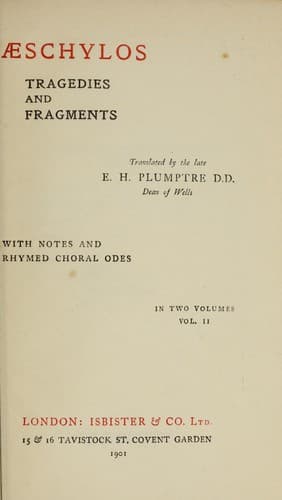
Aeschylus -- Translations into English; Mythology, Greek -- Drama
By an Attic law, analogous in principle to that of the Jews, (Num.
xxxvi. 8; 1 Chron. xxiii. 22), heiresses were absolutely bound to
marry their next of kin, if he claimed his right. The king at once
asserts this as the law which was _primâ facie_ applicable to the
case, and declares himself ready to surrender it if the petitioners
can show that their own municipal law is on the other side. He will
not thrust his country's customs upon foreigners, who can prove that
they live under a different rule, but in the absence of evidence must
act on the law which he is bound officially to recognise.
Footnote 238:
_Sc._, the pollution which the statues of the Gods would contract if
they carried into execution their threat of suicide.
Footnote 239:
Inachos, the river-God of Argos, and as such contrasted with Neilos.
Footnote 240:
_i.e._, “Unconsecrate,” marked out by no barriers, accessible to all,
and therefore seeming to offer but little prospect of a safe asylum.
The place described seems to have been an open piece of turf rather
than a grove of trees.
Footnote 241:
Comp. the narrative as given in _Prometheus Bound_, vv. 660, _et seq._
Footnote 242:
Teuthras' fort, or Teuthrania, is described by Strabo (xii. p. 571) as
lying between the Hellespont and Mount Sipylos, in Magnesia.
Footnote 243:
Kypros, as dedicated to the worship of Aphrodite, and famous for its
wine, and oil, and corn.
Footnote 244:
The question, what caused the mysterious exceptional inundations of
the Nile, occupied, as we see from Herodotos (ii. c. 19-27), the minds
of the Greeks. Of the four theories which the historian discusses,
Æschylos adopts that which referred it to the melting of the snows on
the mountains of central Africa.
Footnote 245:
Typhon, the mythical embodiment of the power of evil, was fabled to
have wandered over Egypt, seeking the body of Osiris. Isis, to baffle
him, placed coffins in all parts of Egypt, all empty but the one which
contained the body.
Footnote 246:
The fame of the Nile for the purity of its water, after the earthy
matter held in solution had been deposited, seems to have been as
great in the earliest periods of its history as it is now.
Footnote 247:
Io was represented as a woman with a heifer's head, and was probably a
symbolic representation of the moon, with her crescent horns.
Sometimes the transformation is described (as in v. 294) in words
which imply a more thorough change.
Footnote 248:
Perhaps—
“For not as subject sitting 'neath the sway
Of strength above his own.”
Footnote 249:
The passage takes its place among the noblest utterances of a faith
passing above the popular polytheism to the thought of one sovereign
Will ruling and guiding all things, as Will—without effort, in the
calmness of a power irresistible.
Footnote 250:
Public-domain text, read in full here on John Shaqi.
Reviews
Reviews
No reviews yet
Be the first to share your thoughts on this work.
Elsewhere in the archive
Join the Discussion
Join the discussion
Sign in to leave a comment or review.
Sign InorCreate an account