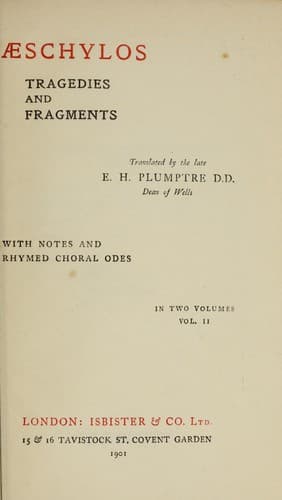
Aeschylus -- Translations into English; Mythology, Greek -- Drama
The form of gambling from which the phrase is taken, had clearly
become common in Attica among the class to which the watchman was
supposed to belong, and had given rise to proverbial phrases like that
in the text. The Greeks themselves supposed it to have been invented
by the Lydians (Herod. i. 94), or Palamedes, one of the heroes of the
tale of Troïa, but it enters also into Egyptian legends (Herod. ii.
122), and its prevalence from remote antiquity in the farther East, as
in the Indian story of Nala and Damayanti, makes it probable that it
originated there. The game was commonly played, as the phrase shows,
with three dice, the highest throw being that which gave three sixes.
Æschylos, it may be noted, appears in a lost drama, which bore the
title of _Palamedes_, to have brought the game itself into his plot.
It is referred to, as invented by that hero, in a fragment of
Sophocles (_Fr._ 380), and again in the proverb,—
“The dice of Zeus have ever lucky throws.”—(_Fr._ 763.)
Footnote 272:
Here, also, the watchman takes up another common proverbial phrase,
belonging to the same group as that of “kicking against the pricks” in
v. 1624. He has his reasons for silence, weighty as would be the tread
of an ox to close his lips.
Footnote 273:
The vultures stand, _i.e._, to the rulers of Heaven, in the same
relation as the foreign sojourners in Athens, the _Metoics_, did to
the citizens under whose protection they placed themselves.
Footnote 274:
Alexandros, the other name of Paris, the seducer of Helen.
Footnote 275:
The words, perhaps, refer to the grief of Menelaos, as leading him to
neglect the wonted sacrifices to Zeus, but it seems better to see in
them a reference to the sin of Paris. He, at least, who had carried
off his host's wife, had not offered acceptable sacrifices, had
neglected all sacrifices to Zeus Xenios, the God of host and guest.
The allusion to the sacrifice of Iphigeneia, which some (Donaldson and
Paley) have found here, and the wrath of Clytæmnestra, which Agamemnon
will fail to soothe, seems more far-fetched.
Footnote 276:
An allusion, such as the audience would catch and delight in, to the
well-known enigma of the Sphinx. See Sophocles (_Trans._), p. 1.
Footnote 277:
Public-domain text, read in full here on John Shaqi.
Reviews
Reviews
No reviews yet
Be the first to share your thoughts on this work.
Elsewhere in the archive
Join the Discussion
Join the discussion
Sign in to leave a comment or review.
Sign InorCreate an account