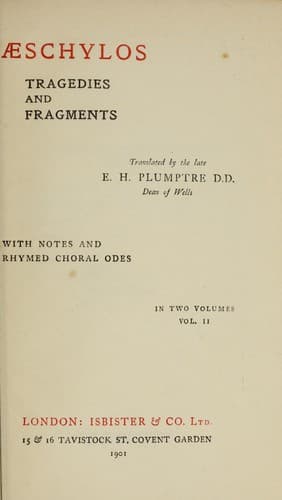
Aeschylus -- Translations into English; Mythology, Greek -- Drama
Here, and again in v. 612, we have a similitude drawn from the
metallurgy of Greek artists. Good bronze, made of copper and tin,
takes the green rust which collectors prize, but when rubbed, the
brightness reappears. If zinc be substituted for tin, as in our brass,
or mixed largely with it, the surface loses its polish, oxidizes and
becomes black. It is, however, doubtful whether this combination of
metals was at the time in use, and the words may simply refer to
different degrees of excellence in bronze properly so called.
Footnote 301:
In a corrupt passage like this, the text of which has been so
variously restored and rendered, it may be well to give at least one
alternative version:
“There stands she silent, with no honour met,
Nor yet with words of scorn,
Sweetest to see of all that he has lost.”
The words, as so taken, refer to the vision of Helen, described in the
lines that follow. Another, for the line “In deepest woe,” &c., ...
would give,
“Believing not he sees the lost one there.”
Footnote 302:
The art of Pheidias had already made it natural at Athens to speak of
kings as decorating their palaces with the life-size busts or statues
of those they loved.
Footnote 303:
Here again one may note a protest against the aggressive policy of
Pericles, an assertion of the principle that a nation should be
content with independence, without aiming at supremacy.
Footnote 304:
Perhaps passively, “Soon suffers trespassers.”
Footnote 305:
As the play opens on the morning of the day on which Troïa was taken,
and now we have the arrivals, first, of the herald, and then of
Agamemnon, after the capture has been completed, and the spoil
divided, and the fleet escaped a storm, an interval of some days must
be supposed between the two parts of the play, the imaginary law of
the unities notwithstanding.
Footnote 306:
The customary adornment of heralds who brought good news. Comp.
Sophocles, _Œd. K._ v. 83. The custom prevailed for many centuries,
and is recognised by Dante, _Purg._ ii. 70, as usual in his time in
Italy.
Footnote 307:
So in the _Seven against Thebes_ (v. 494), smoke is called “the sister
of fire.”
Footnote 308:
A probable reference, not only to the story, but to the actual words
of Homer, _Il._ i. 45-52.
Footnote 309:
Specially the Dioscuri, Castor and Polydeukes.
Footnote 310:
Such a position (especially in the case of Zeus or Apollo) was common
in the temples both of Greece and Rome, and had a very obvious
signification. As the play was performed, the actual hour of the day
probably coincided with that required by the dramatic sequence of
events, and the statues of the Gods were so placed on the stage as to
catch the rays of the morning sun when the herald entered. Hence the
allusion to the bright “cheerful glances” would have a visible as well
as ethical fitness.
Public-domain text, read in full here on John Shaqi.
Reviews
Reviews
No reviews yet
Be the first to share your thoughts on this work.
Elsewhere in the archive
Join the Discussion
Join the discussion
Sign in to leave a comment or review.
Sign InorCreate an account