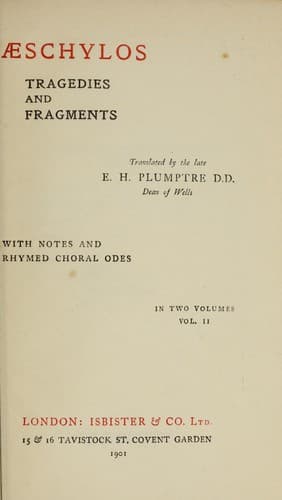
Aeschylus -- Translations into English; Mythology, Greek -- Drama
Footnote 311:
It formed part of the guilt of Paris, that, besides his seduction of
Helena, he had carried off part of the treasures of Menelaos.
Footnote 312:
The idea of a payment twofold the amount of the wrong done, as a
complete satisfaction to the sufferer, was common in the early
jurisprudence both of Greeks and Hebrews (Exod. xxii. 4-7). In some
cases it was even more, as in the four or fivefold restitution of
Exod. xxii. 1. In the grand opening of Isaiah's message of glad
tidings the fact that Jerusalem has received “double for all her sins”
is made the ground on the strength of which she may now hope for
pardon. Comp. also Isa. lxi. 7; Zech. ix. 12.
Footnote 313:
Perhaps—
“Full hardly, and the close and crowded decks.”
Footnote 314:
So stress is laid upon this form of hardship, as rising from the
climate of Troïa, by Sophocles, _Aias_, 1206.
Footnote 315:
One may conjecture that here also, as with the passage describing the
succession of beacon fires (vv. 281-314), the description would have
for an Athenian audience the interest of recalling personal
reminiscences of some recent campaign in Thrakè, or on the coasts of
Asia.
Footnote 316:
We may, perhaps, think of the herald, as he speaks, placing some
representative trophy upon the pegs on the pedestals of the statues of
the great Gods of Hellas, whom he had invoked on his entrance.
Footnote 317:
Or,
“So that to this bright morn our sons may boast,
As they o'er land and ocean take their flight,
'The Argive host of old, who captured Troïa,
These spoils of battle to the Gods of Hellas,
Hung on their pegs, a trophy of old days.'”
Footnote 318:
The husband, on his departure, sealed up his special treasures. It was
the glory of the faithful wife or the trusty steward to keep these
seals unbroken.
Footnote 319:
There is an ambiguity, possibly an intentional one, in the comparison
which Clytæmnestra uses. If there was no such art as that of “staining
bronze” (or copper) known at the time, the words would be a natural
phrase enough to describe what was represented as an impossibility.
Later on in the history of art, however, as in the time of Plutarch, a
process so described (perhaps analogous to enamelling) is mentioned
(_De Pyth. Orac_. § 2) as common. If we suppose the art to have been a
mystery known to the few, but not to the many, in the time of
Æschylos, then the words would have for the hearers the point of a
_double entendre_. She seems to the mass to disclaim what yet, to
those in the secret she acknowledges.
Public-domain text, read in full here on John Shaqi.
Reviews
Reviews
No reviews yet
Be the first to share your thoughts on this work.
Elsewhere in the archive
Join the Discussion
Join the discussion
Sign in to leave a comment or review.
Sign InorCreate an account