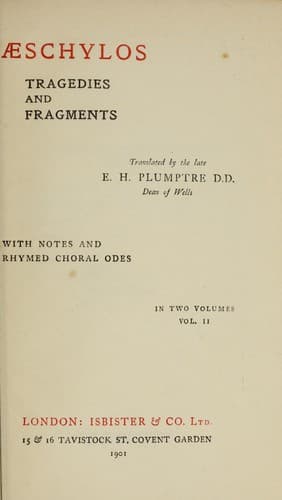
Aeschylus -- Translations into English; Mythology, Greek -- Drama
The poet becomes a prophet, and asserts what it has been given him to
know of the righteous government of God. The dominant creed of Greece
at the time was, that the Gods were envious of man's prosperity, that
this alone, apart from moral evil, was enough to draw down their
wrath, and bring a curse upon the prosperous house. So, _e.g._, Amasis
tells Polycrates (Herod. iii. 40) that the unseen Divinity that rules
the world is envious, that power and glory are inevitably the
precursors of destruction. Comp. also the speech of Artabanos (Herod.
vii. 10, 46). Against this, in the tone of one who speaks singlehanded
for the truth, Æschylos, through the Chorus, enters his protest.
Footnote 328:
_Sc._, Agamemnon, by the sacrifice of Iphigeneia, had induced his
troops to persevere in an expedition from which, in their inmost
hearts, they shrank back with strong dislike. A conjectural reading
gives,
“By the sacrifice he offered
Giving death-doomed men false boldness.”
Footnote 329:
The tone of ambiguous irony mingles, it will be seen, even here, with
the praises of the Chorus.
Footnote 330:
Possibly an allusion to Pandora's box. Here, too, Hope alone was left,
but it only came up to where the curve of the rim began, not to its
top. The imagery is drawn from the older method of voting, in which
(as in _Eumenides_, v. 678) the votes for condemnation and acquittal
were cast into separate urns.
Footnote 331:
The lion, as the symbol of the house of Atreus, still seen in the
sculptures of Mykenæ; the horse, in allusion to the stratagem by which
Troïa had been taken.
Footnote 332:
At the end of autumn, and therefore at a season when a storm like that
described by the herald would be a probable incident enough.
Footnote 333:
So in Sophocles, Philoctetes (v. 1025) taunts Odysseus:—
“And yet thou sailedst with them by constraint,
By tricks fast bound.”
Footnote 334:
Geryon appears in the myth of Hercules as a monster with three heads
and three bodies, ruling over the island Erytheia, in the far West,
beyond Hesperia. To destroy him and seize his cattle was one of the
“twelve labours,” with which Hesiod (_Theogon._ vv. 287-294) had
already made men familiar.
Footnote 335:
When a man is buried, there is earth above and earth below him.
Clytæmnestra having used the words “coverlet,” pauses to make her
language accurate to the very letter. She is speaking only of the
earth which would have been laid over her husband's corpse, had he
died as often as he was reported to have done. She will not utter
anything so ominous as an allusion to the depths below him stretching
down to Hades.
Footnote 336:
Or—
“Weeping because the torches in thy house
No more were lighted as they were of yore.”
Footnote 337:
Public-domain text, read in full here on John Shaqi.
Reviews
Reviews
No reviews yet
Be the first to share your thoughts on this work.
Elsewhere in the archive
Join the Discussion
Join the discussion
Sign in to leave a comment or review.
Sign InorCreate an account