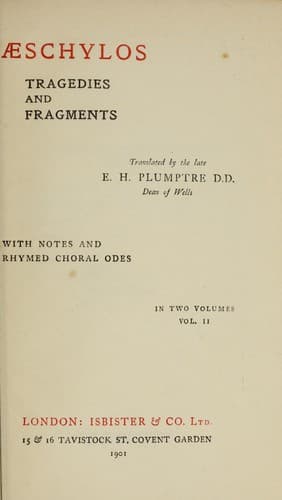
Aeschylus -- Translations into English; Mythology, Greek -- Drama
Another rendering refers “bronze” to the “sword,” and makes the stains
those of blood; as though she said, “I am as guiltless of adultery as
of murder,” while yet she knew that she had committed the one, and
meant to commit the other. The possibility of such a meaning is
certainly in the words, and with a sharp-witted audience catching at
ænigmas and dark sayings may have added to their suggestiveness. The
ambiguous comment of the Chorus shows that they read, as between the
lines, the shameful secret which they knew, but of which the Herald
was ignorant.
Footnote 320:
The last two lines are by some editors assigned to the Herald.
Footnote 321:
It need hardly be said that it is as difficult to render a
_paronomasia_ of this kind as it is to reproduce those, more or less
analogous, which we find in the prophets of the Old Testament (comp.
especially Micah i.); but it seems better to substitute something
which approaches, however imperfectly, to an equivalent than to
obscure the reference to the _nomen et omen_ by abandoning the attempt
to translate it. “Hell of men, and hell of ships, and hell of towers,”
has been the rendering adopted by many previous translators. The Greek
fondness for this play on names is seen in Sophocles, _Aias_, v. 401.
Footnote 322:
Zephyros, Boreas, and the other great winds were represented in the
_Theogony_ of Hesiod (v. 134) as the offspring of Astræos and Eôs, and
Astræos was a Titan. The west wind was, of course, favourable to Paris
as he went with Helen from Greece to Troïa.
Footnote 323:
Here again the translator has to meet the difficulty of a pun. As an
alternative we might take—
“To Ilion brought, well-named,
A marriage marring all.”
Footnote 324:
The sons of Priam are thought of as taking part in the celebration of
Helen's marriage with Paris, and as, therefore, involving themselves
in the guilt and the penalty of his crime.
Footnote 325:
Here, too, it may be well to give an alternative rendering—
“A mischief in his house,
A man reared, not on milk.”
Home-reared lions seem to have been common as pets, both among Greeks
and Latins (Arist., _Hist. Anim._ ix. 31; Plutarch, _de Cohib. irâ_, §
14, p. 822), sometimes, as in Martial's Epigram, ii. 25, with fatal
consequences. The text shows the practice to have been common enough
in the time of Pericles to supply a similitude.
Footnote 326:
There may, possibly, be a half allusion here to the passage in the
_Iliad_ (vv. 154-160), which describes the fascination which the
beauty of Helen exercised on the Troïan elders.
Footnote 327:
Public-domain text, read in full here on John Shaqi.
Reviews
Reviews
No reviews yet
Be the first to share your thoughts on this work.
Elsewhere in the archive
Join the Discussion
Join the discussion
Sign in to leave a comment or review.
Sign InorCreate an account