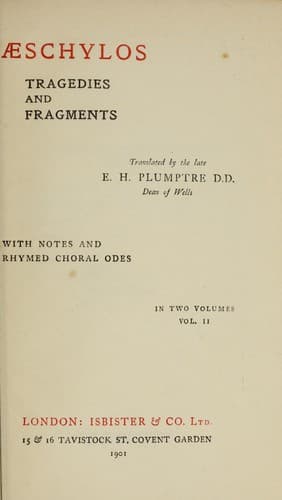
Aeschylus -- Translations into English; Mythology, Greek -- Drama
Footnote 345:
The words of Isaiah (xviii. 5), “when the sour grape is ripening in
the flower,” present an almost verbal parallel.
Footnote 346:
The ever-recurring ambiguity of Clytæmnestra's language is again
traceable, as is also her fondness for rhetorical similitudes.
Footnote 347:
The Chorus speaks in perplexity. In cannot get rid of its forebodings,
and yet it would seem as if the time for the fulfilment of the dark
words of Calchas must have passed long since. It actually sees the
safe return of the leader of the host, yet still its fears haunt it.
Footnote 348:
Asclepios, whom Zeus smote with his thunderbolt for having restored
Hippolytos to life.
Footnote 349:
The Chorus, in spite of their suspicions and forebodings, have given
the king no warning. They excuse themselves by the plea of necessity,
the sovereign decree of Zeus overruling all man's attempts to
withstand it.
Footnote 350:
Cassandra is summoned to an act of worship. The household is gathered,
the altar to Zeus Ktesios (the God of the family property, slaves
included), standing in the servants' hall, is ready. The new slave
must come in and take her place with the others.
Footnote 351:
As in the story which forms the groundwork of the _Trachiniæ_ of
Sophocles, vv. 250-280, that Heracles had been sold to Omphale as a
slave, in penalty for the murder of Iphitos.
Footnote 352:
Political as well as dramatic. The Eupatrid poet appeals to public
opinion against the _nouveaux riches_, the tanners and lamp-makers,
who were already beginning to push themselves forward towards
prominence and power. The way was thus prepared in the first play of
the Trilogy for what is known to have been the main object of the
last. Comp. Arist., _Rhet._ ii. 32.
Footnote 353:
Here again the translator has the task of finding an English
_paronomasia_ which approximates to that of the Greek, between Apollo
and ἀπόλλων _the destroyer_. To Apollo, as the God of paths
(_Aguieus_), an altar stood, column-fashion, before the street-door of
every house, and to such an altar, placed by the door of Agamemnon's
palace, Cassandra turns, with the twofold play upon the name.
Footnote 354:
This refers, probably, to the death of Hippodameia, the wife of
Pelops, who killed herself, in remorse for the death of Chrysippos, or
fear of her husband's anger. The horrors of the royal house of Argos
pass, one by one, before the vision of the prophetess, and this leads
the procession, followed by the spectres of the murdered children of
Thyestes.
Footnote 355:
The Chorus, as in their last ode, had made up their minds, though
foreboding ill, to let destiny take its course. They do not wish that
policy of non-interference to be changed by any too clear vision of
the future.
Footnote 356:
Public-domain text, read in full here on John Shaqi.
Reviews
Reviews
No reviews yet
Be the first to share your thoughts on this work.
Elsewhere in the archive
Join the Discussion
Join the discussion
Sign in to leave a comment or review.
Sign InorCreate an account