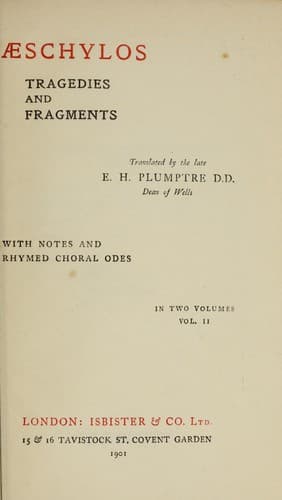
Aeschylus -- Translations into English; Mythology, Greek -- Drama
The Chorus understands the vision of the _clairvoyante_ as regards the
past tragedy of the house of Atreus, but not that which seems to
portend another actually imminent.
Footnote 357:
Fresh visions come before the eyes of the seeress. She beholds the
company of Erinnyes hovering over the accursed house, and calls on
them to continue their work till the new crime has met with its due
punishment. The murder which she sees as if already wrought, demands
death by stoning.
Footnote 358:
The “yellow” look of fear is thought of as being caused by an actual
change in the colour of the blood as it flows through the veins to the
heart.
Footnote 359:
Here there is prevision as well as clairvoyance. The deed is not yet
done. The sacrifice and the feast are still going on, yet she sees the
crime in all its circumstances.
Footnote 360:
As before (v. 115) the black eagle had been the symbol of the
warrior-chief, so here the black-horned bull, that being one of the
notes of the best breed of cattle. A various reading gives “with _her_
swarthy horn.”
Footnote 361:
What the Chorus had just said as to the fruitlessness of prophetic
insight tallied all too well with her own bitter experience.
Footnote 362:
The ecstasy of horror interrupts the tenor of her speech, and the
second “thou” is addressed not to the Chorus, but to Agamemnon, whose
death Cassandra has just witnessed in her vision.
Footnote 363:
The song of the nightingale, represented by these sounds, was
connected with a long legend, specially Attic in its origin.
Philomela, daughter of Pandion, king of Attica, suffered outrage at
the hands of Tereus, who was married to her sister Procne, and was
then changed into a nightingale, destined ever to lament over the fate
of Itys her sister's son. The earliest form of the story appears in
the _Odyssey_ (xix. 518). Comp. Sophocles, _Electr._ v. 148.
Footnote 364:
In the marriage-rites of the Greeks of the time of Æschylos, the bride
for three days after the wedding wore her veil; then, as now no longer
shrinking from her matron life, she laid it aside and looked on her
husband with unveiled face.
Footnote 365:
The picture might be drawn by any artist of power, but we may,
perhaps, trace a reproduction of one of the grandest passages in the
_Iliad_ (iv. 422-426).
Footnote 366:
So in the _Eumenides_ (v. 293), the Erinnyes appear as vampires,
drinking the blood of their victims.
Footnote 367:
The death of Myrtilos as the first crime in the long history of the
house of Pelops. Comp. Soth. _Electr._ v. 470. The “defiler” is
Thyestes, who seduced Aerope, the wife of Atreus.
Footnote 368:
The horror of the Thyestes banquet again haunts her as the source of
all the evils that followed, of the deaths both of Iphigenia and
Agamemnon. The “stay-at-home” is Ægisthos.
Footnote 369:
Public-domain text, read in full here on John Shaqi.
Reviews
Reviews
No reviews yet
Be the first to share your thoughts on this work.
Elsewhere in the archive
Join the Discussion
Join the discussion
Sign in to leave a comment or review.
Sign InorCreate an account