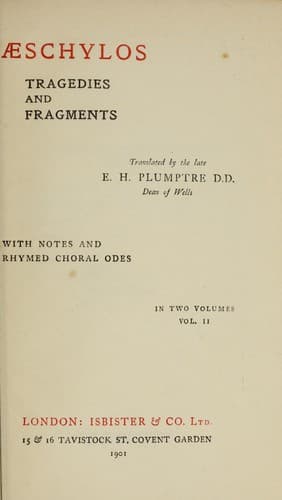
Aeschylus -- Translations into English; Mythology, Greek -- Drama
_Kilis._ Our mistress bids me with all speed to call
Ægisthos to the strangers, that he come
And hear more clearly, as a man from man,
This newly-brought report. Before her slaves,
Under set eyes of melancholy cast,
She hid her inner chuckle at the events
That have been brought to pass—too well for her,
But for this house and hearth most miserably,—
As in the tale the strangers clearly told.
He, when he hears and learns the story's gist,
Will joy, I trow, in heart. Ah, wretched me! 730
How those old troubles, of all sorts made up,
Most hard to bear, in Atreus' palace-halls
Have made my heart full heavy in my breast!
But never have I known a woe like this.
For other ills I bore full patiently,
But as for dear Orestes, my sweet charge,
Whom from his mother I received and nursed....
And then the shrill cries rousing me o' nights.
And many and unprofitable toils
For me who bore them. For one needs must rear
The heedless infant like an animal, 740
(How can it else be?) as his humour serves.
For while a child is yet in swaddling clothes,
*It speaketh not, if either hunger comes,
Or passing thirst, or lower calls of need;
And children's stomach works its own content.
And I, though I foresaw this, call to mind
How I was cheated, washing swaddling clothes,
And nurse and laundress did the self-same work.
I then with these my double handicrafts,
Brought up Orestes for his father dear;
And now, woe's me! I learn that he is dead, 750
And go to fetch the man that mars this house:
And gladly will he hear these words of mine.
_Chor._ And how equipped then doth she bid him come?
_Nurse._ 'How?' Speak again that I may better learn.
_Chor._ By spearmen followed, or himself alone?
_Nurse._ She bids him bring his guards with lances armed.
_Chor._ Nay, say not that to him thy lord doth hate.[443]
But bid him 'come alone,' (that so he hear
Without alarm,) 'full speed, with joyous mind,'
Since 'secret speech with messengers goes best.' 760
_Nurse._ And art thou of good cheer at this my tale?
_Chor._ But what if Zeus will turn the tide of ill?
_Nurse._ How so? Orestes, our one hope is gone.
_Chor._ Not yet; a sorry seer might know thus much.
_Nurse._ What say'st thou? Know'st thou aught besides my tale?
_Chor._ Go tell thy message; do thine errand well:
The Gods for what they care for, care enough.
_Nurse._ I then will go, complying with thy words:
May all, by God's gift, end most happily!
STROPHE I
_Chor._ Now to my prayer, O Father of the Gods 770
Of high Olympos, Zeus,
Grant that their fortune may be blest indeed
*Who long to look on goodness prospering well,
Yea, with full right and truth
I speak the word—O Zeus, preserve thou him!
STROPHE II
Public-domain text, read in full here on John Shaqi.
Reviews
Reviews
No reviews yet
Be the first to share your thoughts on this work.
Elsewhere in the archive
Join the Discussion
Join the discussion
Sign in to leave a comment or review.
Sign InorCreate an account