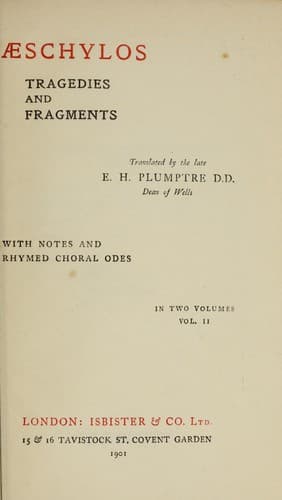
Aeschylus -- Translations into English; Mythology, Greek -- Drama
_Orest._ See ye this country's tyrant rulers twain, 960
My father's murderers, wasters of his house;
Stately were they, seen sitting on their thrones,
Friends too e'en now, to argue from their fate,
Whose oaths are kept to every pledge they gave.
Firmly they swore that they would slay my father,
And die together. Well those oaths are kept:
And ye who hear these ills, behold ye now
Their foul device, as bonds for my poor father,
Handcuffs, and fetters both his feet to bind.
Come, stretch it out, and standing all around, 970
Show ye the snare that wrapt him o'er, that He
May see, our Father,—not of mine I speak,
But the great Sun that looks on all we do,—
My mother's deeds, defilèd and impure,
That He may be a witness in my cause,
That I did justly bring this doom to pass
Upon my mother.... Of Ægisthos' fate
No word I speak. He bears the penalty,
As runs the law, of an adulterer's guilt;
But she who planned this crime against a man
By whom she knew the weight of children borne
Beneath her girdle, once a burden loved,
But now, as it is proved, a grievous ill, 980
What seems she to you? Had she viper been,
Or fell myræna,[461] she with touch alone,
*Rather than bite, had made a festering sore
With that bold daring of unrighteous mood.
What shall I call it, using mildest speech?
A wild beast's trap?—a pall that wraps a bier,
And hides a dead man's feet?—A net, I trow,
A snare, a robe entangling, one might call it.
Such might be owned by one to plunder trained,
Practised in duping travellers, and the life
That robs men of their money; with this trap 990
Destroying many, many deeds of ill
His fevered brain might hatch. May such as she
Ne'er share my dwelling! May the hand of God
Far rather smite me that I childless die!
_Chor._ [_looking on_ AGAMEMNON'S _robe._] Ah me! ah me! these deeds
most miserable!
By hateful murder thou wast done to death.
Woe, woe is me!
And evil buds and blooms for him that's left.
_Orest._ Was the deed hers or no? Lo! this same robe
Bears witness how she dyed Ægisthos' sword,
And the blood-stain helps Time's destroying work, 1000
Marring full many a tint of pattern fair:
*Now name I it, now as eye-witness wail;[462]
And calling on this robe that slew my father,
Moan for all done and suffered, wail my race,
Bearing the foul stains of this victory.
_Chor._ No mortal man shall live a life unharmed,
*Stout-hearted and rejoicing evermore.
Woe, woe is me!
One trouble vexes now, another comes.
Public-domain text, read in full here on John Shaqi.
Reviews
Reviews
No reviews yet
Be the first to share your thoughts on this work.
Elsewhere in the archive
Join the Discussion
Join the discussion
Sign in to leave a comment or review.
Sign InorCreate an account