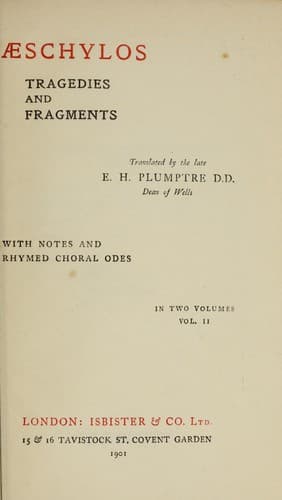
Aeschylus -- Translations into English; Mythology, Greek -- Drama
_Chor._ The man she slew was not one of blood with her.[517]
_Orest._ And does my mother's blood then flow in me?
_Chor._ E'en so; how else, O murderer, reared she thee
Within her womb? Disown'st thou mother's blood?
_Orest._ [_Turning to_ APOLLO.] Now bear thou witness, and declare to
me,
Apollo, if I slew her righteously; 580
For I the deed, as fact, will not deny.
But whether right or wrong this deed of blood
Seem in thine eyes, judge thou that these may hear.
_Apol._ I will to you, Athena's solemn council,
Speak truly, and as prophet will not lie.
Ne'er have I spoken on prophetic throne,
Of man, or woman, or of commonwealth,
But as great Zeus, Olympian Father, bade;
And that ye learn how much this plea avails,
I bid you [_turning to the court of jurymen_] follow out my Father's
will;590
No oath can be of greater might than Zeus.[518]
_Chor._ Zeus, then, thou say'st, did prompt the oracle
That this Orestes here, his father's blood
Avenging, should his mother's rights o'erthrow?
_Apol._ 'Tis a quite other thing for hero-chief,
Bearing the honour of Zeus-given sceptre,
To die, and at a woman's hands, not e'en
By swift, strong dart, from Amazonian bow,[519]
But as thou, Pallas, now shalt hear, and those
Who sit to give their judgment in this cause; 600
For when he came successful from the trade
Of war with largest gains, receiving him
With kindly words of praise, she spread a robe
Over the bath, yes, even o'er its edge,
As he was bathing, and entangling him
In endless folds of cloak of cunning work,
She strikes her lord down. Thus the tale is told
Of her lord's murder, chief whom all did honour,
The ships' great captain. So I tell it out,
E'en as it was, to thrill the people's hearts,
Who now are set to give their verdict here.
_Chor._ Zeus then a father's death, as thou dost say, 610
Of highest moment holds, yet He himself
Bound fast in chains his aged father, Cronos;[520]
Are not thy words at variance with the facts?
I call on you [_to the Court_] to witness what he says.
_Apol._ O hateful creatures, loathèd of the Gods,
Those chains may be undone, that wrong be cured,
And many a means of rescue may be found:
But when the dust has drunk the blood of men,
No resurrection comes for one that's dead:
No charm for these things hath my sire devised;
But all things else he turneth up or down, 620
And orders without toil or weariness.[521]
_Chor._ Take heed how thou help this man to escape;
Shall he who stained earth with his mother's blood
Then dwell in Argos in his father's house?
What public altars can he visit now?
What lustral rite of clan or tribe admit him?[522]
Public-domain text, read in full here on John Shaqi.
Reviews
Reviews
No reviews yet
Be the first to share your thoughts on this work.
Elsewhere in the archive
Join the Discussion
Join the discussion
Sign in to leave a comment or review.
Sign InorCreate an account