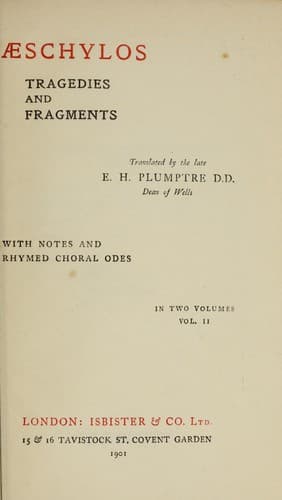
Aeschylus -- Translations into English; Mythology, Greek -- Drama
The maxim, “Marry with a woman thine equal,” was ascribed to Pittacos.
Footnote 201:
The Euhemerism of later scholiasts derived the name from a king
Adrastos, who was said to have been the first to build a temple to
Nemesis, and so the power thus worshipped was called after his name. A
better etymology leads us to see in it the idea of the “inevitable”
law of retribution working unseen by men, and independently even of
the arbitrary will of the Gods, and bringing destruction upon the
proud and haughty.
Footnote 202:
Comp. _Agam._ 162-6.
Footnote 203:
Either a mere epithet of intensity, as in our “thrice blest,” or
rising from the supposed fact that every third wave was larger and
more impetuous than the others, like _fluctus decumanus_ of the
Latins, or from the sequence of three great waves which some have
noted as a common phenomenon in storms.
Footnote 204:
Here again we have a strange shadowing forth of the mystery of
Atonement, and what we have learnt to call “vicarious” satisfaction.
In the later legend, Cheiron, suffering from the agony of his wounds,
resigns his immortality, and submits to die in place of the
ever-living death to which Prometheus was doomed.
Footnote 205:
It is noticeable that both Æschylos and Sophocles have left us
tragedies which end in a thunderstorm as an element of effect. But the
contrast between the _Prometheus_ and the _Œdipus at Colonos_ as to
the impression left in the one case of serene reconciliation, and in
the other of violent antagonism, is hardly less striking than the
resemblance in the outward phenomena which are common to the two.
THE SUPPLIANTS
DRAMATIS PERSONÆ
DANAOS
Herald
PELASGOS, _king of_ Argos
_Chorus of the daughters of_ DANAOS
_ARGUMENT.—When Io, after many wanderings, had found refuge in Egypt,
and having been touched by Zeus, had given birth to Epaphos, it came to
pass that he and his descendants ruled over the region of Canôpos, near
one of the seven mouths of Neilos. And in the fifth generation there
were two brothers, Danaos and Ægyptos, the sons of Belos, and the former
had fifty daughters and the latter fifty sons, and Ægyptos sought the
daughters of Danaos in marriage for his sons. And they, looking on the
marriage as unholy, and hating those who wooed them, took flight and
came to Argos, where Pelasgos then ruled as king, as to the land whence
Io, from whom they sprang, had come. And thither the sons of Ægyptos
followed them in hot pursuit._
SCENE.—Argos, _the entrance of the gates. Statues of_ ZEUS,
ARTEMIS, _and other Gods, placed against the walls_
Public-domain text, read in full here on John Shaqi.
Reviews
Reviews
No reviews yet
Be the first to share your thoughts on this work.
Elsewhere in the archive
Join the Discussion
Join the discussion
Sign in to leave a comment or review.
Sign InorCreate an account