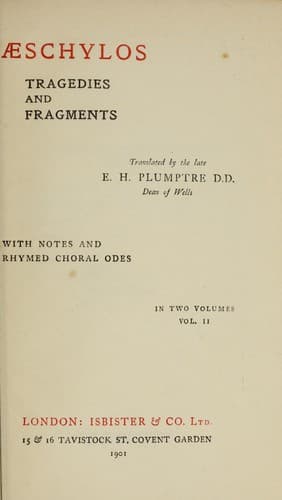
Aeschylus -- Translations into English; Mythology, Greek -- Drama
Kisthene belongs to the geography of legend, lying somewhere on the
shore of the great ocean-river in Lybia or Æthiopia, at the end of the
world, a great mountain in the far West, beyond the Hesperides, the
dwelling-place, as here, of the Gorgons, the daughters of Phorkys.
Those first-named are the Graiæ.
Footnote 189:
Here, like the “wingèd hound” of v. 1043, for the eagles that are the
messengers of Zeus.
Footnote 190:
We are carried back again from the fabled West to the fabled East. The
Arimaspians, with one eye, and the Grypes or Gryphons (the griffins of
mediæval heraldry), quadrupeds with the wings and beaks of eagles,
were placed by most writers (Herod. iv. 13, 27) in the north of
Europe, in or beyond the _terra incognita_ of Skythia. The mention of
the “ford of Pluto” and Æthiopia, however, may possibly imply (if we
identify it, as Mr. Paley does, with the Tartessos of Spain, or
Bœtis—_Guadalquivir_) that Æschylos followed another legend which
placed them in the West. There is possibly a _paronomasia_ between
Pluto, the God of Hades, and Plutos, the ideal God of riches.
Footnote 191:
The name was applied by later writers (Quintus Curtius, iv. 7, 22;
Lucretius, vi. 848) to the fountain in the temple of Jupiter Ammon in
the great Oasis. The “river Æthiops” may be purely imaginary, but it
may also suggest the possibility of some vague knowledge of the Niger,
or more probably of the Nile itself in the upper regions of its
course. The “Bybline hills” carry the name Byblos, which we only read
of as belonging to a town in the Delta, to the Second Cataract.
Footnote 192:
Comp. Sophocles, _Trachin._, v. 1168.
Footnote 193:
The Adriatic or Ionian Gulf.
Footnote 194:
In the _Suppliants_, Zeus is said to have soothed her, and restored
her to her human consciousness by his “divine breathings.” The thought
underlying the legend may be taken either as a distortion of some
primitive tradition, or as one of the “unconscious prophecies” of
heathenism. The deliverer is not to be born after the common manner of
men, and is to have a divine as well as a human parentage.
Footnote 195:
See the argument of the _Suppliants_, who, as the daughters of Danaos,
descended from Epaphos, are here referred to. The passage is
noticeable as showing that the theme of that tragedy was already
present to the poet's thoughts.
Footnote 196:
Argos. So in the _Suppliants_, Pelasgos is the mythical king of the
Apian land who receives them.
Footnote 197:
Hypermnæstra, who spared Lynceus, and by him became the mother of Abas
and a line of Argive kings.
Footnote 198:
Heracles, who came to Caucasos, and with his arrows slew the eagle
that devoured Prometheus.
Footnote 199:
The word is simply an interjection of pain, but one so characteristic
that I have thought it better to reproduce it than to give any English
equivalent.
Footnote 200:
Public-domain text, read in full here on John Shaqi.
Reviews
Reviews
No reviews yet
Be the first to share your thoughts on this work.
Elsewhere in the archive
Join the Discussion
Join the discussion
Sign in to leave a comment or review.
Sign InorCreate an account