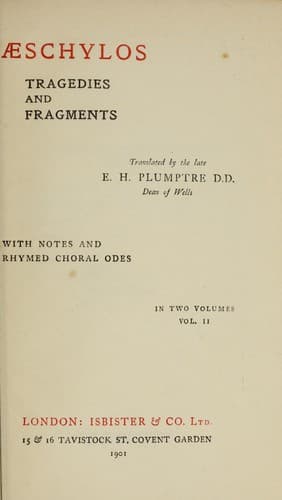
Aeschylus -- Translations into English; Mythology, Greek -- Drama
_King._ Nay, for that matter, answer thou and speak
Without alarm. Palæchthon's son am I,
Earth-born, the king of this Pelasgic land;
And named from me, their king,[229] as well might be,
The race Pelasgic reaps our country's fruits;
*And all the land through which the Strymon pours 250
Its pure, clear waters to the West I rule;
And as the limits of my realm I mark
The land of the Perrhæbi, and the climes
Near the Pæonians, on the farther side
Of Pindos, and the Dodonæan heights;[230]
And the sea's waters form its bounds. O'er all
Within these coasts I govern; and this plain,
The Apian land, itself has gained its name
Long since from one who as a healer lived;[231]
For Apis, coming from Naupactian land
That lies beyond the straits, Apollo's son,
Prophet and healer, frees this land of ours 260
From man-destroying monsters, which the soil,
Polluted with the guilt of blood of old,
By anger of the Gods, brought forth,—fierce plagues,
The dragon-brood's dread, unblest company;
And Apis, having for this Argive land
Duly wrought out his saving surgery,
Gained his reward, remembered in our prayers;
And thou, this witness having at my hands,
May'st tell thy race at once, and further speak;
Yet lengthened speech our city loveth not.
_Chor._ Full short and clear our tale. We boast that we
Are Argives in descent, the children true 270
Of the fair, fruitful heifer. And all this
Will I by what I speak show firm and true.
_King._ Nay, strangers, what ye tell is past belief
For me to hear, that ye from Argos spring;
For ye to Libyan women are most like,[232]
And nowise to our native maidens here.
Such race might Neilos breed, and Kyprian mould,
Like yours, is stamped by skilled artificers
On women's features; and I hear that those
Of India travel upon camels borne, 280
Swift as the horse, yet trained as sumpter-mules,
E'en those who as the Æthiops' neighbours dwell.
And had ye borne the bow, I should have guessed,
Undoubting, ye were of th' Amâzon's tribe,
Man-hating, flesh-devouring. Taught by you,
I might the better know how this can be,
That your descent and birth from Argos come.
_Chor._ They tell of one who bore the temple-keys
Of Hera, Io, in this Argive land.
_King._ So was't indeed, and wide the fame prevails:
And was it said that Zeus a mortal loved? 290
_Chor._ And that embrace was not from Hera hid.
_King._ What end had then these strifes of sovereign Ones?
_Chor._ The Argive goddess made the maid a heifer.
_King._ Did Zeus that fair-horned heifer still approach?
_Chor._ So say they, fashioned like a wooing steer.
_King._ How acted then the mighty spouse of Zeus?
_Chor._ She o'er the heifer set a guard all-seeing.
_King._ What herdsman strange, all-seeing, speak'st thou of?
_Chor._ Argos, the earth-born, him whom Hermes slew. 300
Public-domain text, read in full here on John Shaqi.
Reviews
Reviews
No reviews yet
Be the first to share your thoughts on this work.
Elsewhere in the archive
Join the Discussion
Join the discussion
Sign in to leave a comment or review.
Sign InorCreate an account