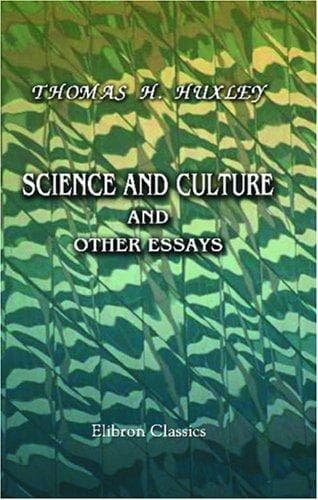
Science and Culture, and Other EssaysHuxley, Thomas Henry
Philosophy
Science and Culture, and Other Essays
Huxley, Thomas Henry
Science
A month ago I should have gone on to say that one might speedily
expect changes of another kind in Oxford and Cambridge. A Commission
has been inquiring into the revenues of the many wealthy societies, in
more or less direct connection with the Universities, resident in those
towns. It is said that the Commission has reported, and that, for the
first time in recorded history, the nation, and perhaps the Colleges
themselves, will know what they are worth. And it was announced that a
statesman, who, whatever his other merits or defects, has aims above
the level of mere party fighting, and a clear vision into the most
complex practical problems, meant to deal with these revenues.
But, _Bos locutus est._ That mysterious independent variable of
political calculation, Public Opinion—which some whisper is, in the
present case, very much the same thing as publican’s opinion—has willed
otherwise. The Heads may return to their wonted slumbers—at any rate
for a space.
Is the spirit of change, which is working thus vigorously in the South,
likely to affect the Northern Universities, and if so, to what extent?
The violence of fermentation depends, not so much on the quantity of
the yeast, as on the composition of the wort, and its richness in
fermentable material; and, as a preliminary to the discussion of this
question, I venture to call to your minds the essential and fundamental
differences between the Scottish and the English type of University.
Do not charge me with anything worse than official egotism, if I say
that these differences appear to be largely symbolised by my own
existence. There is no Rector in an English University. Now, the
organisation of the members of an University into Nations, with their
elective Rector, is the last relic of the primitive constitution of
Universities. The Rectorate was the most important of all offices in
that University of Paris, upon the model of which the University of
Aberdeen was fashioned; and which was certainly a great and flourishing
institution in the twelfth century.
Enthusiasts for the antiquity of one of the two acknowledged parents
of all Universities, indeed, do not hesitate to trace the origin of
the “Studium Parisiense” up to that wonderful king of the Franks and
Lombards, Karl, surnamed the Great, whom we all called Charlemagne, and
believed to be a Frenchman, until a learned historian, by beneficent
iteration, taught us better. Karl is said not to have been much of a
scholar himself, but he had the wisdom of which knowledge is only the
servitor. And that wisdom enabled him to see that ignorance is one of
the roots of all evil.
Public-domain text, read in full here on John Shaqi.
Reviews
Reviews
No reviews yet
Be the first to share your thoughts on this work.
Join the Discussion
Join the discussion
Sign in to leave a comment or review.
Sign InorCreate an account