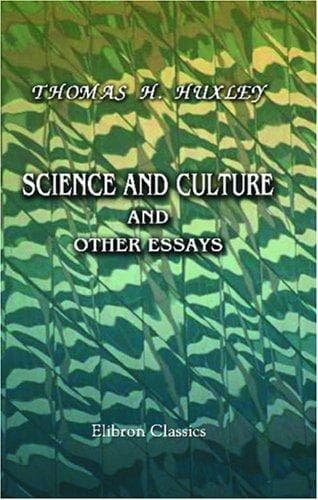
Science and Culture, and Other Essays — John Shaqi
Science and Culture, and Other EssaysHuxley, Thomas Henry
Philosophy
Science and Culture, and Other Essays
Huxley, Thomas Henry
Science
The scholars seem to have studied Grammar, Logic, and Rhetoric;
Arithmetic and Geometry; Astronomy; Theology; and Music. Thus, their
work, however imperfect and faulty, judged by modern lights, it may
have been, brought them face to face with all the leading aspects of
the many-sided mind of man. For these studies did really contain, at
any rate in embryo—sometimes, it may be, in caricature—what we now call
Philosophy, Mathematical and Physical Science, and Art. And I doubt if
the curriculum of any modern University shows so clear and generous
a comprehension of what is meant by culture, as this old Trivium and
Quadrivium does.
The students who had passed through the University course, and had
proved themselves competent to teach, became masters and teachers of
their younger brethren. Whence the distinction of Masters and Regents
on the one hand, and Scholars on the other.
Rapid growth necessitated organisation. The Masters and Scholars of
various tongues and countries grouped themselves into four Nations; and
the Nations, by their own votes at first, and subsequently by those
of their Procurators, or representatives, elected their supreme head
and governor, the Rector—at that time the sole representative of the
University, and a very real power, who could defy Provosts interfering
from without; or could inflict even corporal punishment on disobedient
members within the University.
Such was the primitive constitution of the University of Paris. It is
in reference to this original state of things that I have spoken of the
Rectorate, and all that appertains to it, as the sole relic of that
constitution.
But this original organisation did not last long. Society was not
then, any more than it is now, patient of culture, as such. It says to
everything, “Be useful to me, or away with you.” And to the learned,
the unlearned man said then, as he does now, “What is the use of all
your learning, unless you can tell me what I want to know? I am here
blindly groping about, and constantly damaging myself by collision
with three mighty powers, the power of the invisible God, the power
of my fellow Man, and the power of brute Nature. Let your learning
be turned to the study of these powers, that I may know how I am to
comport myself with regard to them.” In answer to this demand, some
of the Masters of the Faculty of Arts devoted themselves to the study
of Theology, some to that of Law, and some to that of Medicine; and
they became Doctors—men learned in those technical, or, as we now call
them, professional, branches of knowledge. Like cleaving to like, the
Doctors formed schools, or Faculties, of Theology, Law, and Medicine,
which sometimes assumed airs of superiority over their parent, the
Faculty of Arts, though the latter always asserted and maintained its
fundamental supremacy.
Public-domain text, read in full here on John Shaqi.
Reviews
Reviews
No reviews yet
Be the first to share your thoughts on this work.
Join the Discussion
Join the discussion
Sign in to leave a comment or review.
Sign InorCreate an account