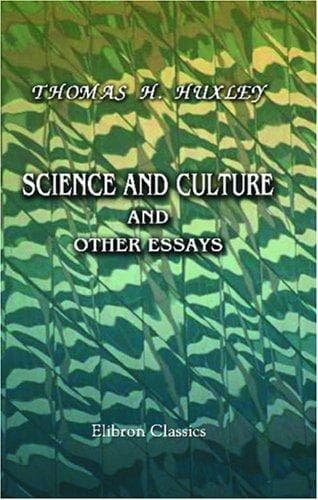
Science and Culture, and Other Essays — John Shaqi
Science and Culture, and Other EssaysHuxley, Thomas Henry
Philosophy
Science and Culture, and Other Essays
Huxley, Thomas Henry
Science
The founders of Universities held the theory that the Scriptures and
Aristotle taken together, the latter being limited by the former,
contained all knowledge worth having, and that the business of
philosophy was to interpret and co-ordinate these two. I imagine
that in the twelfth century this was a very fair conclusion from
known facts. Nowhere in the world, in those days, was there such an
encyclopædia of knowledge of all three classes, as is to be found in
those writings. The scholastic philosophy is a wonderful monument of
the patience and ingenuity with which the human mind toiled to build up
a logically consistent theory of the Universe, out of such materials.
And that philosophy is by no means dead and buried, as many vainly
suppose. On the contrary, numbers of men of no mean learning and
accomplishment, and sometimes of rare power and subtlety of thought,
hold by it as the best theory of things which has yet been stated. And,
what is still more remarkable, men who speak the language of modern
philosophy, nevertheless think the thoughts of the schoolmen. “The
voice is the voice of Jacob, but the hands are the hands of Esau.”
Every day I hear “Cause,” “Law,” “Force,” “Vitality,” spoken of as
entities, by people who can enjoy Swift’s joke about the meat-roasting
quality of the smoke-jack, and comfort themselves with the reflection
that they are not even as those benighted schoolmen.
Well, this great system had its day, and then it was sapped and mined
by two influences. The first was the study of classical literature,
which familiarised men with methods of philosophising; with conceptions
of the highest Good; with ideas of the order of Nature; with notions of
Literary and Historical Criticism; and, above all, with visions of Art,
of a kind which not only would not fit into the scholastic scheme, but
showed them a pre-Christian, and indeed altogether un-Christian world,
of such grandeur and beauty that they ceased to think of any other.
They were as men who had kissed the Fairy Queen, and wandering with her
in the dim loveliness of the underworld, cared not to return to the
familiar ways of home and fatherland, though they lay, at arm’s length,
overhead. Cardinals were more familiar with Virgil than with Isaiah;
and Popes laboured, with great success, to re-paganise Rome.
Public-domain text, read in full here on John Shaqi.
Reviews
Reviews
No reviews yet
Be the first to share your thoughts on this work.
Join the Discussion
Join the discussion
Sign in to leave a comment or review.
Sign InorCreate an account