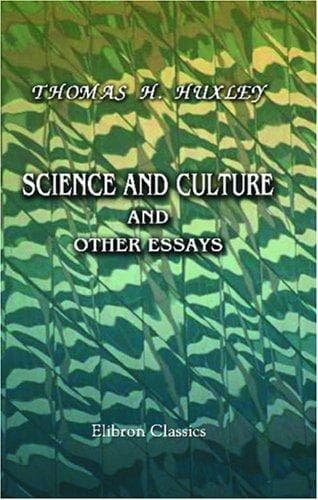
Science and Culture, and Other EssaysHuxley, Thomas Henry
Philosophy
Science and Culture, and Other Essays
Huxley, Thomas Henry
Science
Once upon a time, a boy, with nothing to depend upon but his own
vigorous nature, was thrown into the thick of the struggle for
existence in the midst of a great manufacturing population. He seems
to have had a hard fight, inasmuch as, by the time he was thirty
years of age, his total disposable funds amounted to twenty pounds.
Nevertheless, middle life found him giving proof of his comprehension
of the practical problems he had been roughly called upon to solve, by
a career of remarkable prosperity.
Finally, having reached old age with its well-earned surroundings of
“honour, troops of friends,” the hero of my story bethought himself of
those who were making a like start in life, and how he could stretch
out a helping hand to them.
After long and anxious reflection this successful practical man
of business could devise nothing better than to provide them with
the means of obtaining “sound, extensive, and practical scientific
knowledge.” And he devoted a large part of his wealth and five years of
incessant work to this end.
I need not point the moral of a tale which, as the solid and spacious
fabric of the Scientific College assures us, is no fable, nor can
anything which I could say intensify the force of this practical answer
to practical objections.
We may take it for granted then, that, in the opinion of those best
qualified to judge, the diffusion of thorough scientific education is
an absolutely essential condition of industrial progress; and that the
College which has been opened to-day will confer an inestimable boon
upon those whose livelihood is to be gained by the practice of the arts
and manufactures of the district.
The only question worth discussion is, whether the conditions, under
which the work of the College is to be carried out, are such as to give
it the best possible chance of achieving permanent success.
Sir Josiah Mason, without doubt most wisely, has left very large
freedom of action to the trustees, to whom he proposes ultimately to
commit the administration of the College, so that they may be able to
adjust its arrangements in accordance with the changing conditions
of the future. But, with respect to three points, he has laid most
explicit injunctions upon both administrators and teachers.
Party politics are forbidden to enter into the minds of either, so
far as the work of the College is concerned; theology is as sternly
banished from its precincts; and finally, it is especially declared
that the College shall make no provision for “mere literary instruction
and education.”
It does not concern me at present to dwell upon the first two
injunctions any longer than may be needful to express my full
conviction of their wisdom. But the third prohibition brings us face to
face with those other opponents of scientific education, who are by no
means in the moribund condition of the practical man, but alive, alert,
and formidable.
Public-domain text, read in full here on John Shaqi.
Reviews
Reviews
No reviews yet
Be the first to share your thoughts on this work.
Join the Discussion
Join the discussion
Sign in to leave a comment or review.
Sign InorCreate an account