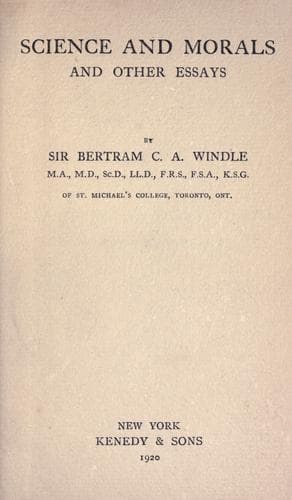
Science and Morals and Other EssaysWindle, Bertram Coghill Alan, Sir
Religion
Science and Morals and Other Essays
Windle, Bertram Coghill Alan, Sir
Essays; Religion and science; Science
In his interesting book, already mentioned, Dr. Johnstone called
attention to the power possessed by living matter of reversing the
process; but no reversal of this kind and extent can make up for the
constant degradation of energy which is taking place all round us. We
mention this because it shows that "energy" cannot, in any case, afford
an eternal solution, but only a temporal and therefore a limited one. No
one doubts that there is energy in the living thing, nor that there are
what the author calls "complexes of energies." No one, again, will
quarrel with the statement that energy is first seen in the sun, in the
earth, in the air, and in the water; that "with life something new
appears in the universe, namely, a union of the internal and external
adjustment of energy which we appropriately call an _Organism_." That
"the germ is an energy complex" is no doubt an unproved hypothesis, as
he admits, but is quite likely. With all these assertions we may agree,
though we cannot with that which follows, namely, that energy is
creative, for that such is impossible in any true sense of that word we
have already tried to show.
We have now to ask ourselves in what way this energy conception of life
differs from, or goes beyond, the two theories of life--mechanistic and
vitalistic, which have hitherto been supposed to have exhausted the
possibilities of explanation. In order to do this we must analyse the
author's idea of energy and its relationship to biological processes a
little more closely. He begins his study of life and its evolution by
considering how nutrition and the derivation of energy can have taken
place before chlorophyl had come into existence; and he very pertinently
points to the _prototrophic_ bacteria as probably representing "the
survival of a primordial stage of life chemistry." Thus a "primitive
feeder," the bacterium _Nitrosomonas_, "for combustion ... takes in
oxygen directly through the intermediate action of iron, phosphorus or
manganese, each of the single cells being a powerful little chemical
laboratory which contains oxidising catalysers, the activity of which
is accelerated by the presence of iron and manganese. Still, in the
primordial stage, _Nitrosomonas_ lives on ammonium sulphate, taking its
energy (food) from the nitrogen of ammonium and forming nitrates. Living
symbiotically with it is _Nitrobacter_, which takes its energy (food)
from the nitrates formed by _Nitrosomonas_, oxidising them into
nitrates. Thus these two species illustrate in its simplest form our law
of the _interaction of an organism_ (_Nitrobacter_) _with its life
environment_ (_Nitrosomonas_)" (p. 82, author's italics).
Public-domain text, read in full here on John Shaqi.
Reviews
Reviews
No reviews yet
Be the first to share your thoughts on this work.
Elsewhere in the archive
Join the Discussion
Join the discussion
Sign in to leave a comment or review.
Sign InorCreate an account