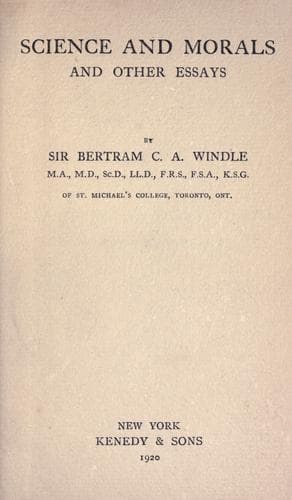
Science and Morals and Other EssaysWindle, Bertram Coghill Alan, Sir
Religion
Science and Morals and Other Essays
Windle, Bertram Coghill Alan, Sir
Essays; Religion and science; Science
The alternative is Blind Chance; and the author, after considering the
question, agrees, as again most reasonable persons will agree, that
Blind Chance is no explanation of things as they are. He quotes a modern
chemist who, discussing the probability of the environmental fitness of
the earth for life being a mere chance process, remarks: "There is, in
truth, not one chance in countless millions of millions that the many
unique properties of carbon, hydrogen, and oxygen, and especially of
their stable compounds, water and carbonic acid, which chiefly make up
the atmosphere of a new planet, should simultaneously occur in the three
elements otherwise than through the operation of a natural law which
somehow connects them together. There is no greater probability that
these unique properties should be without due cause uniquely favourable
to the organic mechanism" (J. J. Henderson, 1913).
If neither of the classic points of view is tenable, what then is the
explanation, if, indeed, any be possible? The author casts one brief
glance down that blind-alley marked "Element Way." Does some known
element or some unknown element, to which the name _Bion_ might be
given, exist and form the source of the energy in living things? Radium
has only been known to us for a few years; can we say that there is no
such thing as Bion? Of course we cannot; but this we can say, that, if
there is such an element and if it is really responsible for all the
protean manifestations of life, wonderful as radium and its doings are,
they must sink into nothingness beside those of this new and unsuspected
entity. The author evidently does not think that this path is a
profitable one to pursue, and we agree with him; so he turns his
attention to the question of energy. Energy is the capacity for doing
work. It is often, of course, latent, as, for example, in a cordite
cartridge, which is a peaceful, harmless thing until the energy stored
up in it is realised with the accompanying explosion and work is done.
It is the same with a bent spring; a clock-weight when the clock is not
going, and so on.
We need not develop this matter further; but one point must be alluded
to, namely, the gradual exhaustion of the available energy in the
changes from one manifestation to another. In all physical processes
heat is evolved, which heat is distributed by conduction and radiation
and tends to become universally diffused throughout space. When complete
uniformity has been attained, all physical phenomena will come to an
end; in other words, our solar system must come to an end, and it must
have had a beginning. It is a well-known argument. Is there anything to
rewind the clock which is running down before our very eyes? It was once
urged that stellar collisions, and such-like things, might permit us to
postulate a cyclical arrangement (and thus rearrangement) of universal
phenomena; but that hypothesis does not seem to find any supporters
to-day.
Public-domain text, read in full here on John Shaqi.
Reviews
Reviews
No reviews yet
Be the first to share your thoughts on this work.
Elsewhere in the archive
Join the Discussion
Join the discussion
Sign in to leave a comment or review.
Sign InorCreate an account