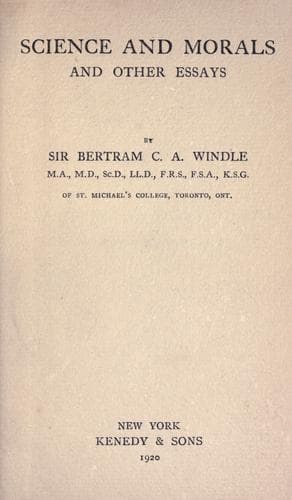
Science and Morals and Other EssaysWindle, Bertram Coghill Alan, Sir
Religion
Science and Morals and Other Essays
Windle, Bertram Coghill Alan, Sir
Essays; Religion and science; Science
It will be admitted by all conversant with the facts that religion could
hardly have been at a lower ebb than it was when what is known as the
Evangelical Movement came to trouble the placid, if stagnant and turbid,
pool of the Established Church. Of course it did not transform the
Church entirely. Read Miss Austen's novels: the most perfect pictures of
life ever written. There are, I suppose, some half-dozen clergymen,
pleasant and unpleasant, depicted in them, and we may be sure that they
fairly well represent the typical average country parson of the period.
Whatever they may otherwise be, they all agree in one point, namely in
the complete absence of any such thing as a trace of spirituality. But
in the early nineteenth-century Evangelicanism--specially that terrible
variety Calvinism--was the dominant factor where religion really
prevailed as a living influence; and it is to its influence, I firmly
believe, that we may attribute the genuine detestation of religion which
was so marked a feature of a part of the Victorian and most of the
succeeding time. I am not, of course, forgetting the Oxford Movement,
but, important as that was and is, in its earlier years it was almost
entirely confined to clerical circles, exercising comparatively little
influence on the laity and practically none at all on that great middle
class which had been so much affected by the Wesleys, Whitefield, Scott,
Newton, and the other pundits of Evangelicanism. Take the characteristic
novel of the movement, if novel it should be called, Newman's _Loss and
Gain_: I do not remember a single male character in it who is not in
Holy Orders or on the way thereto. Hence, so far as religious influences
are concerned, it is to the Evangelical Movement that we have to look.
Now, though in my opinion it was the parent of many evils, there is no
doubt that there was in it real fervour; intense devotion; a genuine
desire to know and do God's will; a burning love for our Lord; coupled
with all which were the most distorted and distorting ideas of what was
and what was not sin ever conceived by any brain. Of this creed I can
speak from personal knowledge, for I was brought up in it and know it
from bitter experience.
Public-domain text, read in full here on John Shaqi.
Reviews
Reviews
No reviews yet
Be the first to share your thoughts on this work.
Join the Discussion
Join the discussion
Sign in to leave a comment or review.
Sign InorCreate an account