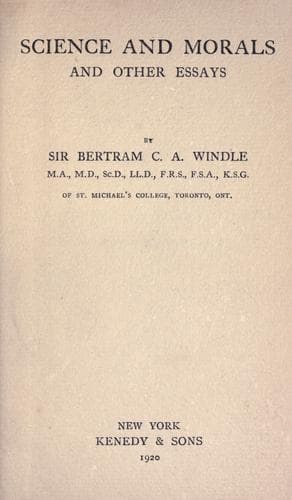
Science and Morals and Other EssaysWindle, Bertram Coghill Alan, Sir
Religion
Science and Morals and Other Essays
Windle, Bertram Coghill Alan, Sir
Essays; Religion and science; Science
Whether my view as to the cause, or one of the causes, is right or not,
the fact remains that by the mid-Victorian period England had fallen to
a very large extent a prey to materialism. Many people attribute the
sudden onslaught of this to the publication of _The Origin of Species_
and the controversies of the foolish which followed thereon. Samuel
Butler, that brilliant writer who has not even yet come into his own,
sums up in his novel _The Way of All Flesh_ (and it may incidentally be
remarked, in himself) most of the characteristics of the day. Many a
parsonage home like that of the Rev. Theobald Pontifex existed in those
days, and more than one Ernest Pontifex emerged from them. Now in this
book Butler states that "the year 1858 was the last of a term during
which the peace of the Church of England was singularly unbroken," and
there no doubt he is right; "The Evangelical Movement ... had become
almost a matter of ancient history. Tractarianism had subsided into a
tenth-day's wonder; it was at work, but it was not noisy." Then he says
the calm was broken by the publication of three books: _Essays and
Reviews_, _The Origin of Species_, _Criticisms on the Pentateuch_ by
Colenso. Few persons probably now remember the first and the last of
these books; the fame of the second is likely to last long.
Whether again Butler is right in his idea as to the causes or not, as to
the fact there can be no doubt. We have arrived at a period when the
prevalent opinion amongst the intellectual classes was that
religion--belief in anything which could not be fully understood--was
impossible once one began to think seriously about it. Those who did not
really look into such questions might go on considering themselves to
believe in revelation, but the moment that a man seriously tackled the
subject, his religion was bound to go, just as that of Ernest Pontifex
did at the end of five minutes' conversation with an atheistic
shoemaker.[21] Agnosticism and materialism were in the air, and remained
the dominant features for quite a number of years. There were those who
deplored the loss of their faith such as it had been. Huxley obviously
did; and Romanes, who afterwards returned to the Church of England,
confessedly did. Such persons, and there were many of them, honestly
were unable to believe, and said so. A great deal of this was due to the
attitude of popular science at that time. It was in a hot fit, and was
going to explain everything, if not to-day, at least to-morrow. Now, as
Sir Oliver Lodge told us before the war, in his book _Continuity_, we
are in a cold fit and we seem only to know that nothing can be known.
Sir Arthur Conan Doyle, best known as the creator of _Sherlock Holmes_,
tells us in a recent book from which I shall have further to quote (_The
New Revelation_, Hodder and Stoughton, 1918): "When I had finished my
medical education in 1882, I found myself, like many young medical men,
Public-domain text, read in full here on John Shaqi.
Reviews
Reviews
No reviews yet
Be the first to share your thoughts on this work.
Join the Discussion
Join the discussion
Sign in to leave a comment or review.
Sign InorCreate an account