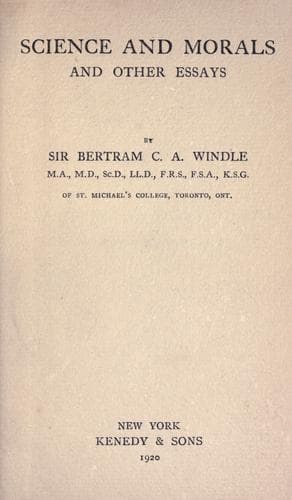
Science and Morals and Other EssaysWindle, Bertram Coghill Alan, Sir
Religion
Science and Morals and Other Essays
Windle, Bertram Coghill Alan, Sir
Essays; Religion and science; Science
We may now turn to the question of Vitalism. It was long the regnant
theory; then temporarily the Cinderella of biology; it is now returning
to its early position, though still denied by those of the older school
of thought who cannot imagine the kitchen wench of yesterday the ruler
of to-day. One of the objections to Vitalism is that this explanation of
living things is thought by ignorant writers to be so inextricably mixed
up with theological considerations as to furnish a case of _stantis aut
cadentis ecclesiae_. That is, of course, absurd; but it creates an
undoubted bias against the theory. Hence it is the fashion amongst its
opponents to write of it as "mystical" or, as Loeb does, as
"supernatural," probably the most illogical term that could possibly be
used. What is Vitalism? It is the theory that there is some other
element--call it entelechy with Driesch, or call it what you like--in
living things than those elements known to chemistry and physics. If it
is _not_ there, _cadit quaestio_; if it _is_ there it is not
"supernatural." It might with reason be called "super-mechanical," or
"super-chemical," or "super-physical"; but if it is in Nature, as it is
held to be, it is not "supernatural" in any true sense of that word--no
dictionary confines the term "Nature" to the operations of chemistry and
physics.
A good deal of the misconception existing on this point comes from pure
ignorance of philosophy, a subject with which writers of this school
seldom have even a nodding acquaintance. "The idea of a quasi-superhuman
intelligence presiding over the forces of the living is met with in the
field of regeneration." Echoes of the Cartesian idea of the soul seem to
ring in this statement; but it could not have been written by anyone who
had mastered the Aristotelian or the Scholastic explanation of matter
and form. But let us take this question of Regeneration; the power which
all living things have, in some measure, though in very different
measure, of reconstructing themselves when injured. It has been dealt
with in a masterly manner by Driesch; and we may at once say that we do
not think that Loeb has in any way contraverted his argument, nor even
entered the first line of defence of that which is built up around what
he calls by the somewhat forbidding name of "Harmonious-Equipotential
System."
Public-domain text, read in full here on John Shaqi.
Reviews
Reviews
No reviews yet
Be the first to share your thoughts on this work.
Join the Discussion
Join the discussion
Sign in to leave a comment or review.
Sign InorCreate an account