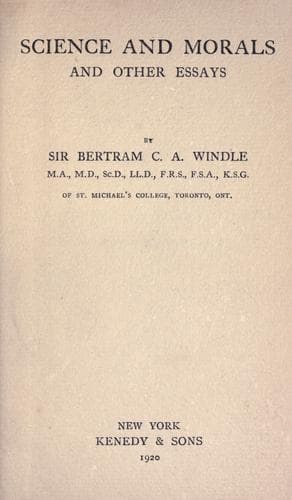
Science and Morals and Other EssaysWindle, Bertram Coghill Alan, Sir
Religion
Science and Morals and Other Essays
Windle, Bertram Coghill Alan, Sir
Essays; Religion and science; Science
To give but one example of this attitude towards the Church, readers may
be reminded that Huxley[23] called the Catholic Church "the vigorous
enemy of the highest life of mankind," and rejoiced that evolution, "in
addition to its truth, has the great merit of being in a position of
irreconcilable antagonism to it." An utterly incorrect, even ignorant
statement, by the way--but let that pass. The same writer, in a number
of places, in season and out of season, as we may fairly say,[24]
proclaims his wholly erroneous view that there is "a necessary
antagonism between science and Roman Catholic doctrine." We need not
labour this point. It is sufficiently obvious, nor does it need any
catena of authorities to establish the fact, that outside the Church,
and even, as we have hinted above, amongst the less-instructed of her
own children, there is a prevalent idea that the allegation with which
this paper proposes to deal is a true bill.
Those who give credit to the allegation must of course ignore certain
very patent facts which are, it will be allowed, a little difficult to
get over. They must commence by ignoring the historical fact that the
greater number--almost all indeed--of the older Universities, places
specially intended to foster and increase knowledge and research, owe
their origin to Papal bulls. They must ignore the fact that vast numbers
of scientific researches, often of fundamental importance, especially
perhaps in the subjects of anatomy and physiology, emanated from learned
men attached to seats of learning in Rome, and this during the Middle
Ages, and that the learned men who were their authors quite frequently
held official positions in the Papal Court. They must finally ignore the
fact that a large number of the most distinguished scientific workers
and discoverers in the past were also devout children of the Catholic
Church. Stensen, "the Father of Geology" and a great anatomical
discoverer as well, was a bishop; Mendel, whose name is so often heard
nowadays in biological controversies, was an abbot. And what about
Galvani, Volta, Pasteur, Schwann (the originator of the Cell Theory),
van Beneden, Johannes Mueller, admitted by Huxley to be "the greatest
anatomist and physiologist among my contemporaries"?[25] What about
Kircher, Spallanzani, Secchi, de Lapparent, to take the names of persons
of different historical periods, and connected with different subjects,
yet all united in the bond of the Faith? To point to these men--and a
host of other names might be cited--is to overthrow at once and finally
the edifice of falsehood reared by enemies of the Church, who, before
erecting it, might reasonably have been asked to look to the security of
their foundations.
Public-domain text, read in full here on John Shaqi.
Reviews
Reviews
No reviews yet
Be the first to share your thoughts on this work.
Join the Discussion
Join the discussion
Sign in to leave a comment or review.
Sign InorCreate an account