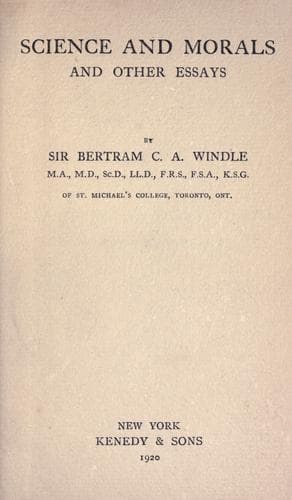
Science and Morals and Other EssaysWindle, Bertram Coghill Alan, Sir
Religion
Science and Morals and Other Essays
Windle, Bertram Coghill Alan, Sir
Essays; Religion and science; Science
What does this mean? In the first place it shows, what all instructed
persons know, that the Royal Society did then exercise the privilege of
giving an _imprimatur_ at any rate to books written by its own Fellows.
It cannot be supposed that such _imprimatur_ guaranteed the accuracy of
all the statements made by Tyson, for we may feel sure that John Hoskins
was quite unable to give any such assurance. We must assume that it
meant that there was nothing in the book which would reflect discredit
upon the Society of which Tyson was a Fellow and from which the
_imprimatur_ was obtained.
However this may be, the sway over its Fellows' publications was
exercised, and indeed very excellent arguments might be adduced for the
reassumption of such a sway even to-day.[26]
Though the _imprimatur_ in question has fallen into desuetude, it is, as
we all know, the commonest of things for the introductions to works of
science to occupy some often considerable part of their space with
acknowledgments of assistance given by learned friends who have read the
manuscript or the proofs and made suggestions with the object of
improving the book or adding to its accuracy. Any person who has written
a book can feel nothing but gratitude towards those who have helped him
to avoid the errors and slips to which even the most careful are
subject.
So that such acknowledgments of assistance have come to be almost what
the lawyers call "common form." What they really amount to is a
proclamation on the part of the author that he has done his best to
ensure that his book is free from mistakes. Now the _imprimatur_ really
amounts to the same thing, for it is, of course, confined to books or
parts of books where theology or philosophy trenching upon theology is
concerned. Thus a book may deal largely, perhaps mainly, with scientific
points, yet necessarily include allusions to theological dogmas. The
_imprimatur_ to such a book would relate solely and entirely to the
theological parts, just as the advice of an architectural authority on a
point connected with that subject in a work in which it was mentioned
only in an incidental manner, would refer to that point, and to nothing
else. Perhaps it should be added, that no author is obliged to obtain an
_imprimatur_ any more than he is compelled to seek advice on any other
point in connection with his book. "_Nihil Obstat_," says the skilled
referee: "I see no reason to suppose that there is anything in all this
which contravenes theological principles." To which the authority
appealed to adds "_imprimatur_:" "Then by all means let it be printed."
The procedure is no doubt somewhat more stately and formal than the
modern system of acknowledgments, yet in actual practice there is but
little to differentiate the two methods of ensuring, so far as is
possible, that the work is free from mistakes. That neither the
assistance of friends nor the _imprimatur_ of authorities is infallible
Public-domain text, read in full here on John Shaqi.
Reviews
Reviews
No reviews yet
Be the first to share your thoughts on this work.
Join the Discussion
Join the discussion
Sign in to leave a comment or review.
Sign InorCreate an account