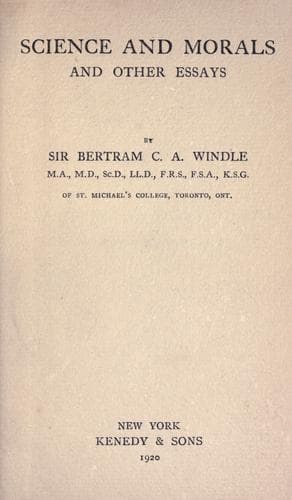
Science and Morals and Other EssaysWindle, Bertram Coghill Alan, Sir
Religion
Science and Morals and Other Essays
Windle, Bertram Coghill Alan, Sir
Essays; Religion and science; Science
Now, if there be a law behind the phenomena made clear to us by
Mendelian experiments (as Mendelians are never tired of asserting), then
it becomes in no way impertinent to ask how that law came into
existence, and who formulated it. Darwinism, according to Driesch,[7]
"explained how by throwing stones one could build houses of a typical
style." In other words, it "claimed to show how something purposively
constructed could arise by absolute chance; at any rate this holds of
Darwinism as codified in the seventies and eighties." Of course the
Blind Chance doctrine breaks down utterly when it comes to be applied to
selected cases, and nothing more definitely disposes of it than the very
definite law which emerges as the result of the Mendelian experiments.
That is obvious to the prophets of Mendelism; but, whilst they admit
this, they will have nothing to say to the lawgiver. That is the
"rankest metaphysics," as Dr. Johnstone puts it,[8] or "mysticism," as
others prefer to call it. And yet nothing is more clear than the
logical sequence that, if you have a law, someone must have made it,
and if you look upon something as "a phenomenon of arrangement," someone
must have arranged it. But for reasons not obvious nor confessed, there
is an objection to make any such admission. Perhaps it is the taint of
the monism of the latter half of the last century which still persists.
At any rate, as I have elsewhere pointed out, there is a most curious
passage in another paper by the same author in which he says: "With the
experimental proof that variation consists largely in the unpacking and
repacking of an original complexity, it is not so certain as we might
like to think that the order of these events is not pre-determined." The
writer hastens to denounce the horrid heresy on the brink of which he
finds himself hesitating, by adding that he sees "no ground whatever for
holding such a view," though "in the light of modern research it
scarcely looks so absurdly improbable as before."[9] It is curious that
the writer in question does not seem to have been in any way influenced
by the eliminative argument so potent in connection with the discussion
on Vitalism. We ask for an explanation of the occurrences--say of
regeneration. We find that no physical explanation in the least meets
the needs of the case, and we are consequently obliged to look for it in
something differing from the operations of chemistry and physics. Of
this argument Dr. Johnstone[10] says: "It is almost impossible to
overestimate the appeal which it makes to the investigator."
Public-domain text, read in full here on John Shaqi.
Reviews
Reviews
No reviews yet
Be the first to share your thoughts on this work.
Join the Discussion
Join the discussion
Sign in to leave a comment or review.
Sign InorCreate an account