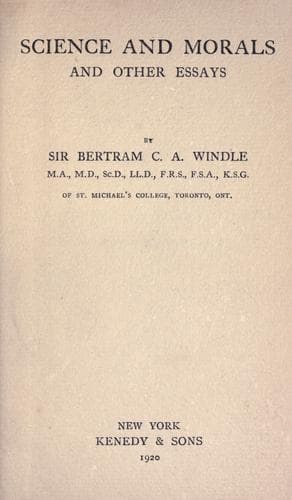
Science and Morals and Other EssaysWindle, Bertram Coghill Alan, Sir
Religion
Science and Morals and Other Essays
Windle, Bertram Coghill Alan, Sir
Essays; Religion and science; Science
Let us look at the history of these dyes. The first aniline dye was
discovered quite by accident, in 1856, by the late Professor W. H.
Perkin. He called it "mauve," from the French word for the mallow, the
colour of whose flower it somewhat resembled. In 1862 there was an
International Exhibition in London; and those who remembered it and its
predecessor of 1851 have declared that the case of aniline
dye-stuffs--for by that time quite a number of new pigments had been
discovered--excited at the later the same attention as that given to the
Koh-i-noor at the earlier. The invention, out of which grew the enormous
German business already alluded to, and with which has been associated
the discovery and manufacture of the synthetic drugs, was entirely
British in its inception and in its early stages. Moreover the raw
materials on which it depended, namely, gas-tar products, were to be had
in greater abundance in England than anywhere else. Yet, at the time
when the war broke out, this industry had been allowed almost entirely
to drift into German hands.
How was this? Let an expert reply. It was due, he tells us, to the
neglect of "the repeated warnings which have been issued since that
time" (_viz._ 1880, by which date the Germans had succeeded in capturing
the trade in question) "in no uncertain voice by Meldola, Green, the
Perkins (father and son), and many other English chemists." Further, he
continues, two causes have invariably been indicated for the transfer of
this industry to Germany--"first the neglect of organic chemistry in the
Universities and colleges of this country" (a neglect which has long
ceased), "and then the disregard by manufacturers of scientific methods
and assistance and total indifference to the practice of research in
connection with their processes and products." I remember talking some
twenty-five years ago to a highly educated young student of Birmingham
who was of German parentage though of English birth. He had just taken
the degree of Doctor of Science in London University, and was on the eve
of abandoning the adopted country of his parents for a position in the
research laboratories of the Badische company, where he would be one
among a number of chemists, running into hundreds, all engaged in
research on gas-tar products. At that moment the great Birmingham
gas-company was employing the services of one trained chemist.
Public-domain text, read in full here on John Shaqi.
Reviews
Reviews
No reviews yet
Be the first to share your thoughts on this work.
Elsewhere in the archive
Join the Discussion
Join the discussion
Sign in to leave a comment or review.
Sign InorCreate an account