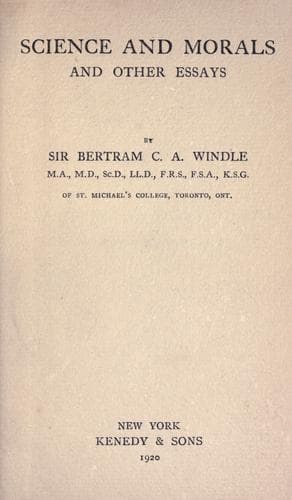
Science and Morals and Other EssaysWindle, Bertram Coghill Alan, Sir
Religion
Science and Morals and Other Essays
Windle, Bertram Coghill Alan, Sir
Essays; Religion and science; Science
So far, everybody whose opinion counts seems to be agreed; but in any
plea for an extended and improved teaching of science, certain points
ought not to be left out of count. In the first place, science is not
the key to all locks; there are many important things--some of the most
important things in life--with which it has nothing whatever to do. It
will be well to recall Mr. Balfour's words at the opening of the
National Physical Laboratory: "Science depends on measurement, and
things not measurable are therefore excluded, or tend to be excluded,
from its attention. But Life and Beauty and Happiness are not
measurable. If there could be a unit of happiness, politics might begin
to be scientific." It follows that there are a number of subjects on
which the scientific man is just as fit, or as unfit, to express an
opinion as any other man. The intense preoccupation which serious
scientific studies demand, may render the man who is engaged therein
even less competent to express an opinion on alien subjects than one
whose attention, less concentrated, has time to range over diverse
fields of study. Readers of Darwin's _Life_ will remember his confession
that he had lost all taste for music, art, and literature; that he
"could not endure to read a line of poetry" and found Shakespeare "so
intolerably dull that it nauseated" him; and finally, that his mind
seemed "to have become a kind of machine for grinding general laws out
of a large collection of facts."
Despite this warning as to the limits of science, we have no lack of
instances of scientific men posing as authorities on subjects on which
they had no real right to be heard, and, what is worse, being accepted
as such by the uninstructed crowd. Thus Professor Huxley, who, as some
one once said, "made science respectable," was wont to utter pontifical
pronouncements on the subject of Home Rule for Ireland. His knowledge of
that country was quite rudimentary, and his visits to it had been as few
and as brief as if he had been its Sovereign; but that did not prevent
him from delivering judgment, nor unfortunately deter many from
following that judgment as if it had been inspired. I am not now arguing
as to the rights and wrongs of Huxley's view on the matter in question:
I have my own opinion on that. What I am urging is that his position,
whether as a zoologist or, incidentally, as a great master of the
English language, in no way entitled him to express an opinion or
rendered him a better authority on such a question than any casual
fellow-traveller in a railway carriage might easily be.
Public-domain text, read in full here on John Shaqi.
Reviews
Reviews
No reviews yet
Be the first to share your thoughts on this work.
Elsewhere in the archive
Join the Discussion
Join the discussion
Sign in to leave a comment or review.
Sign InorCreate an account