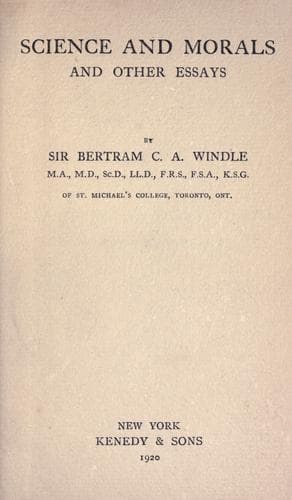
Science and Morals and Other EssaysWindle, Bertram Coghill Alan, Sir
Religion
Science and Morals and Other Essays
Windle, Bertram Coghill Alan, Sir
Essays; Religion and science; Science
Frankfort Moore years ago wrote a pleasant story, called "The Marriage
Lease," in which doctrinaire legislation of a somewhat similar kind was
described, and its inevitable failure most amusingly depicted. The war
disposes of another of the President's maxims (S., p. 10), that the
decline in the birth-rate of a country is nothing to be grieved about,
and that "the slightest acquaintance with biology" shows that the
"inference may be wholly wrong," which asserts that "a nation in which
population is not rapidly increasing must be in a decline" (S., p. 10).
Human nature was neglected in the first-mentioned case, and here it is
the turn of history to pass into the shade, history which, _pace_ the
President, has really a good deal more bearing upon a question of this
kind than the "school-boy natural history" which he thinks capable of
settling it. Thus we advance from breeding to Malthusianism. It is
perhaps not wonderful that our next step should be the quiet, and of
course painless, extinction of the unfit.
"Thou shalt not kill, but needs't not strive
Officiously to keep alive."
Thus wrote Clough; but our author, it appears, would go further than
this. "The preservation of an infant so gravely diseased that it can
never be happy or come to any good is something very like wanton
cruelty. In private life few men defend such interference" (S. 10). And
so such unfortunates should be got rid of, and will be "as soon as
scientific knowledge becomes common property"--when "views more
reasonable, and, I may add, more humane are likely to prevail." Lest we
should be depressed by this massacre of the innocents, we are told that
"man is just beginning to know himself for what he is--a rather
long-lived animal, with great powers of enjoyment if he does not
deliberately forgo them" (S., p. 9). In the past, poor fool that he has
been, he has not availed himself of his opportunities: "Hitherto
superstition and mythical ideas of sin have predominantly controlled
these powers." Let us, however, take heart: "Mysticism will not die out;
for those strange fancies knowledge is no cure; but their forms may
change, and mysticism as a force for the suppression of joy is happily
losing its hold on the modern world" (_ib._, _ib._). Let us eat and
drink--and, it may be added, sin--for to-morrow we die. Such is the new
gospel of science, an old enough gospel, tried and found wanting years
before its latest prophet arose to proclaim it to the world. Surely no
more ridiculous utterance ever was made; for its author evidently did
not pause to consider that the sins which make life pleasant to some
(for example, Thuggery) are apt to have quite another aspect to those
through whose victimisation the pleasure is obtained. There is also here
such a thing as the conscience, which has to be taken into account. Even
the biological hedonist must originally possess such a thing and, it may
be supposed, must deal with it as he would with the gravely diseased
Public-domain text, read in full here on John Shaqi.
Reviews
Reviews
No reviews yet
Be the first to share your thoughts on this work.
Join the Discussion
Join the discussion
Sign in to leave a comment or review.
Sign InorCreate an account